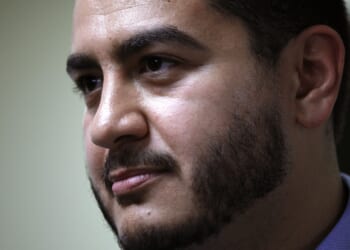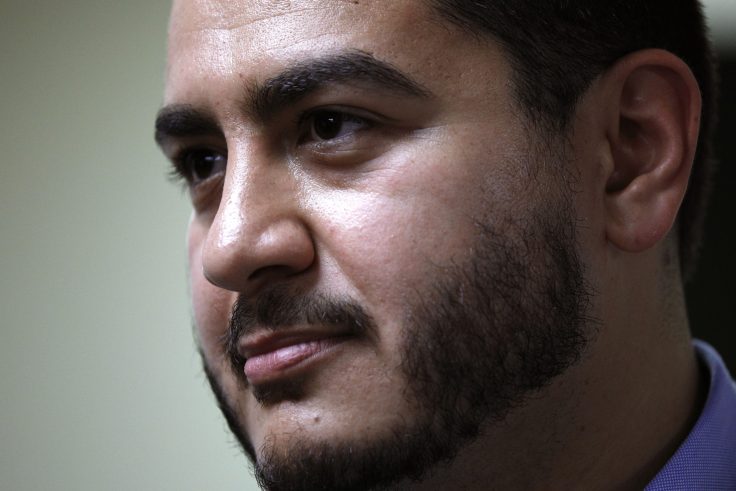
Abdul El-Sayed, the left-wing candidate running in the hotly contested Michigan Democratic Senate primary, suggested at a July 2025 campaign event that terrorists commit “heinous act[s]” because they feel “pain and frustration and a level of lack of agency” due to “hypocritical” U.S. actions that are “creating pain,” video footage exclusively obtained by the Washington Free Beacon shows.
El-Sayed—who is tied with state lawmaker Mallory McMorrow at the top of the Democratic primary, according to a new Emerson College poll that found both candidates with 24 percent support—made the remarks at a campaign stop in South Haven, Mich., after a voter asked him how he would “deal with hostages and terrorism as a U.S. senator.”
“I think the approach that we’ve often taken with terrorism has been to figure out how to leverage the might of the U.S. military to go in and root out, right, certain terrorist organizations, et cetera. And where that’s necessary, that’s necessary,” El-Sayed responded. “But I also think we need to be curious about why those things happen in the first place. Like, what drives somebody to want to commit such a heinous act?”
El-Sayed went on to say that, as a former public health professor, he is “a student of people’s pain,” a perspective he tries to apply to politics. “Like, what, what happens when people are in pain?” he asked.
The candidate’s remarks are a throwback to the so-called root causes debate that unfolded in the years after the 9/11 attacks, when many academics and pundits argued that poverty and desperation across the globe were a major cause of anti-American terrorism. Others pointed out that terrorists were typically educated and well-off and that the argument overlooked the centrality of deep-seated ideological motivations.
El-Sayed’s 2025 remarks suggest he would bring the “root causes” view to the Senate, demanding empathy and understanding for violence against civilians as opposed to a military response.
“One of the things I’ve often come to realize is that when people feel some kind of way about what terrorism is—it’s political violence, doing heinous things in pursuit of a political end, right?” El-Sayed said in 2025. “There is a level of pain and frustration and a level of lack of agency that they have to feel to do something so insane and absurd, right? And so I’ve often tried to ask, like, so what moves somebody into that, and how is it that we’re behaving that may get somebody to think that we don’t see them, and that’s creating pain?”
“And I think too often, the way we’ve engaged in the world has been that we set up this rules-based international order, and then we break the rules of the rules-based international order, and that creates a situation where there are a lot of people who look at us and say that’s hypocritical and that’s wrong,” he went on. “And I think the best thing we can do is be honest about that.”
“I think that’s the thing that I can bring to the table, is an empathy for what it’s like for people seeing America from outside of America,” El-Sayed said. “And I think that’s a perspective that is very lacking in the Senate right now.”
El-Sayed, whose campaign did not respond to a request for comment, is the most left-wing of the three major candidates in the Democratic primary for Michigan’s open Senate seat. His remarks mirror his response to the March 2026 terror attack on the Temple Israel synagogue in West Bloomfield, Mich., in which a Hezbollah-inspired terrorist rammed his car into the synagogue and attempted to murder over 100 children inside.
Addressing that attack ahead of a rally with the anti-American streamer Hasan Piker, El-Sayed said that while “nothing justifies” the attack, it’s “critical for us to understand that hurt people do hurt people, and the circumstances happening 6,000 miles away can affect the lives that we live here, and if we stand against violence, we’ve got to stand against violence, all violence.”
The “hurt” person to whom El-Sayed referred was the perpetrator of the Michigan attack, Ayman Mohamed Ghazali, whose brother was a commander in the Iranian-backed terrorist organization Hezbollah, according to the Israel Defense Forces. Ghazali’s brother died in an Israeli strike in Lebanon days before Ghazali drove his truck into the synagogue.
El-Sayed was born in Michigan to Egyptian immigrants and has written at length about spending his “summers in Egypt” as a teenager. He said at the 2025 event that his experiences there shaped his views on terrorism.
“I was in a position where I would have to explain what’s happening in America to people who are flesh and blood of mine in Egypt, or I’d have to explain what’s happening in Egypt to people who are flesh and blood of mine in America,” El-Sayed said. “And oftentimes, like, I’m not them, but I have a small piece of their understanding because of what I have accessed in the world.”
News of El-Sayed’s remarks comes as the Democrat faces scrutiny over his views of the clerical leaders in Iran and his embrace of far-left actors on the campaign trail.
A day after the assassination of Ayatollah Ali Khamenei, on March 1, El-Sayed privately told staffers he wanted to avoid taking any public position on the event because “there are a lot of people in Dearborn who are sad” about Khamenei’s death, the Free Beacon reported. Dearborn has the largest Muslim population per capita of any city in the United States and became the nation’s first Arab-majority city in 2023. Its mayor, Abdullah Hammoud (D.), has called for the destruction of Israel.
Weeks later, on April 8, El-Sayed campaigned alongside Piker at the University of Michigan and Michigan State University, where he suggested that U.S. lawmakers only support the “genocidal” war in Iran because of money from the “Israel lobby.” Piker—who has said “America deserved 9/11” and argued that it “doesn’t matter if rape happened on October 7″—condemned those who “smeared” him as “radical.”
El-Sayed’s primary opponents, McMorrow and Rep. Haley Stevens, criticized El-Sayed’s decision to campaign alongside Piker. Stevens, the more moderate candidate in the race, said Piker built a career on “hurtful and antisemitic comments.” McMorrow—who said in October that Israel’s war on Hamas met “the definition” of genocide before lamenting months later that the stance has become a “political purity test”—described Piker as “somebody who says extremely offensive things in order to generate clicks.” Stevens trails El-Sayed and McMorrow by 9 points, according to the Emerson poll. McMorrow leads in fundraising, bringing in $8.6 million to El-Sayed’s $7.6 million and Stevens’s $6.8 million, according to the latest campaign finance disclosures.
Earlier this month, El-Sayed’s former security chief, Marine veteran Jordan Domingue, raised concerns about El-Sayed’s foreign policy positions, telling the Michigan Enjoyer that while he tried to move the candidate away from some of his more extreme positions, including opposition to funding Israel’s Iron Dome missile defense system, “they turned out to be beliefs.”