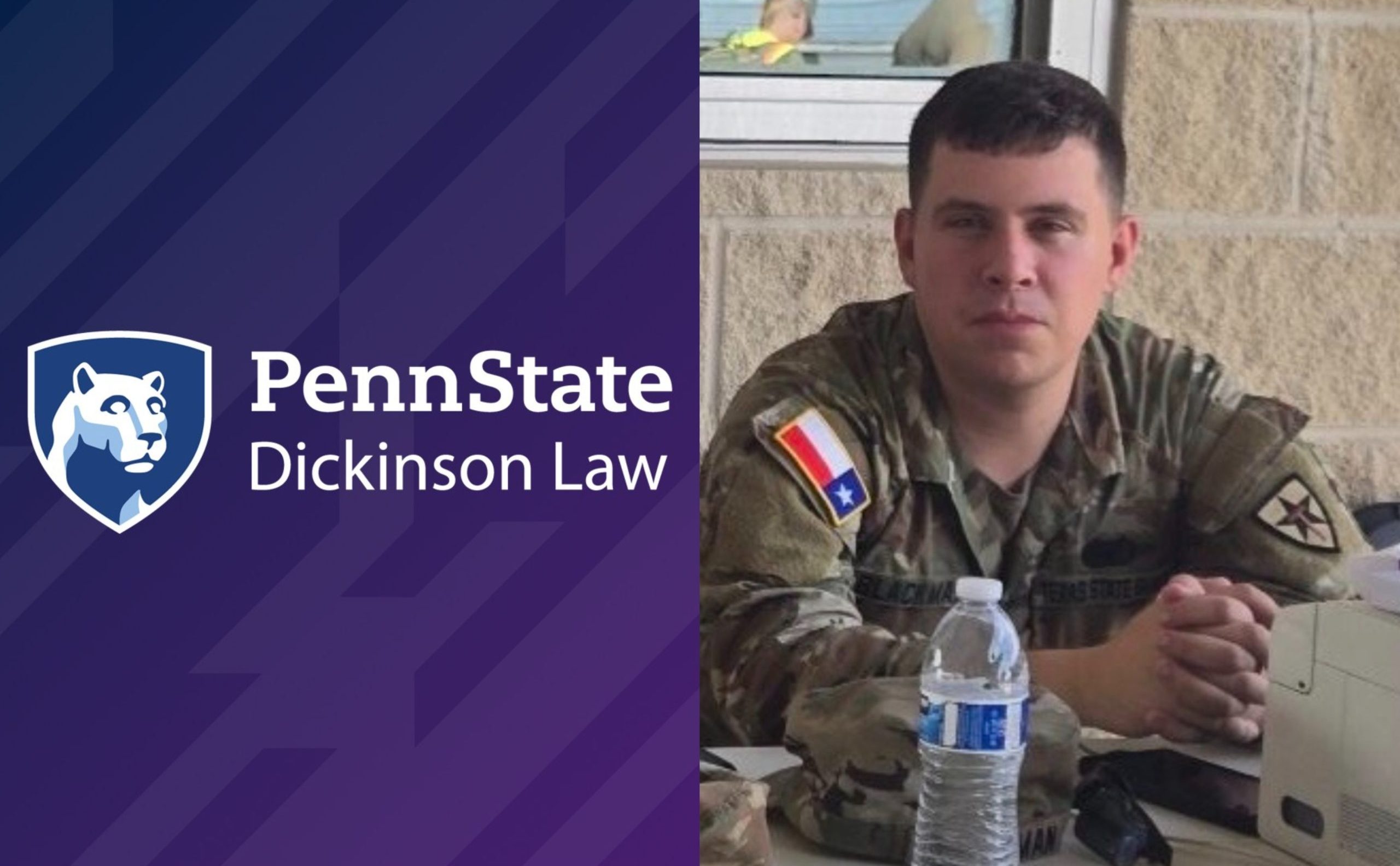
David Blackman, a native of Plano, Texas, was thrilled to be starting law school at Penn State in the fall of 2025.
A former 911 call operator and a veteran of the Texas State Guard, Blackman, 26, loved the university’s football team and its location in the Appalachian Mountains.
“I’ve been a fan of Penn State since I was a teenager,” Blackman told the Washington Free Beacon. He arrived on campus in August 2025, a 50 percent merit scholarship in hand, excited for game nights in Beaver Stadium and a three-year reprieve from the Texas heat.
Then he sat through his first anti-racism class.
On the first day of “Race and the Equal Protection of the Laws,” a required course for all first-year law students, Blackman listened as a transgender faculty member, Emily Spottswood, explained why the course was mandatory.
“It’s not optional,” Spottswood said, because “being a lawyer is about recognizing and combating injustice.”
In audio of the session obtained by the Free Beacon, Spottswood said that this “institutional message” was “baked into” the law school’s “DNA,” adding that, as a “trans woman,” the course’s focus on “combatting oppression … is meaningful to me.”
Spottswood’s remarks followed a presentation by Jeffrey Dodge, the law school’s associate dean, and Shaakirrah Sanders, who was introduced as “the first associate Dean of anti-racism and critical pedagogy in the country.” The presentation made clear that Blackman wasn’t in Texas anymore; he and his classmates were now conscripts in a political “coalition” that, as Dodge put it in his talk, was dedicated to “building a more anti-racist” future.
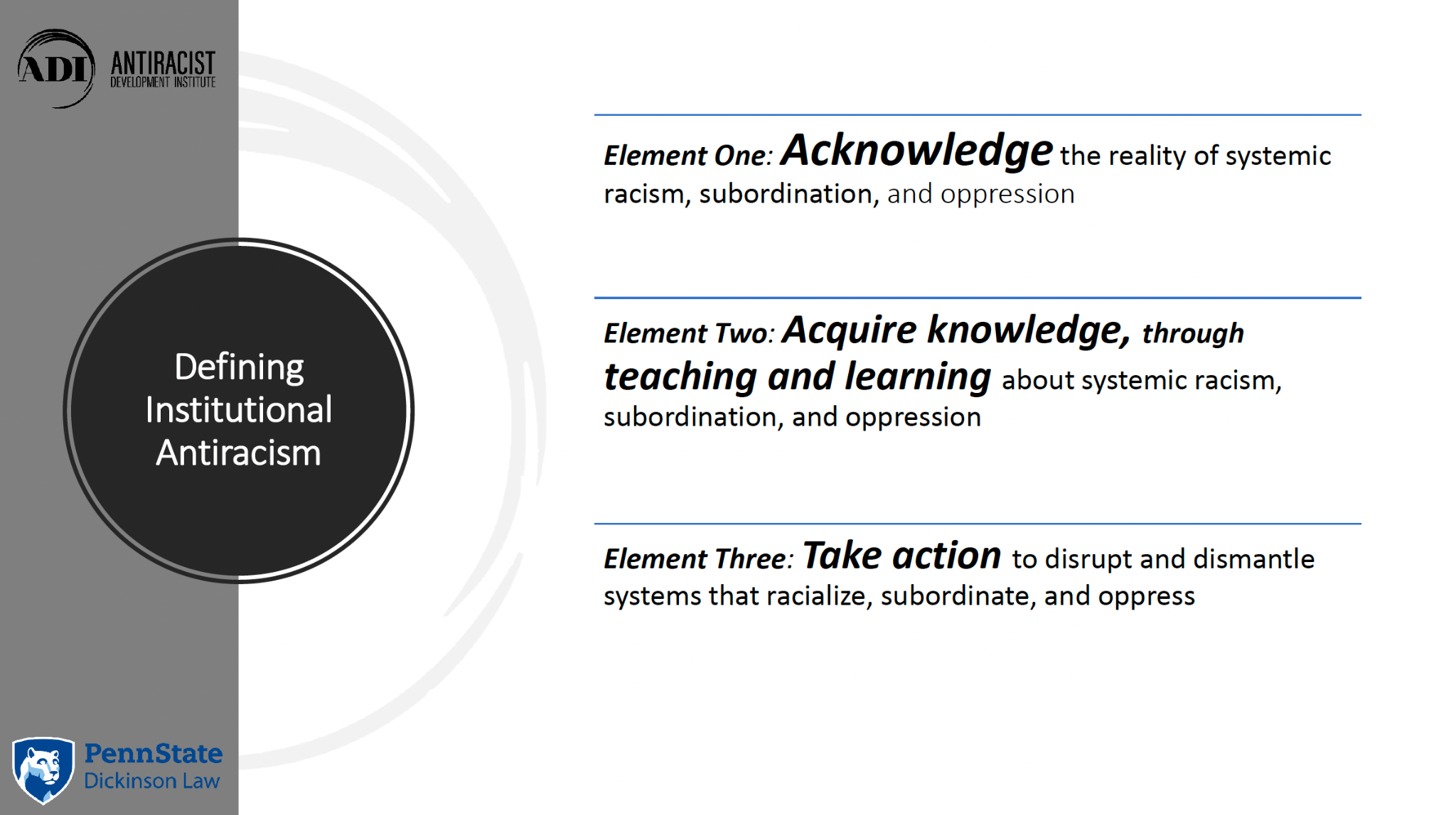
“We are taking action to disrupt and dismantle systems that racialize, subordinate, and oppress,” Dodge said. “We … want to acknowledge the reality of systemic racism … as a foundation for this course.”
Thus began a series of struggle sessions in which professors demanded students affirm activist talking points and ultimately drove Blackman, whose first-choice law school had been Penn State, to withdraw from the school after just one semester. (The Free Beacon reviewed Blackman’s transcript.) Over the course of three 150-minute lectures, speakers described all white people as “privileged,” called to “eradicate patriarchy,” and asserted that the justice system is “about keeping black people in their place.” One assignment said students should “consider” framing their essays around “the reality of systemic racism,” implying that doing otherwise could affect a student’s grade.
“Consider drawing on the instruction we provided on design thinking as a way to frame your assignment,” the essay prompt read. Linked below were slides from the first session of the class, which defined “institutional anti-racism” as “acknowledg[ing] the reality of systemic racism, subordination, and oppression.”
 Launched in 2020 at the height of the George Floyd protests, the class is now raising questions about whether a public law school violated the First Amendment and the Civil Rights Act. Blackman withdrew from the law school after a committee convened by law school dean Danielle Conway refused to grant him an exemption from the course, which he said amounted to compelled speech. In an interview with the Free Beacon, he also noted that the course vilified white people and law enforcement and that professors assigned texts by critical race theorists without presenting an alternative perspective.
“My law degree is not worth sitting through a mandatory DEI class that spits on my entire background,” said Blackman, who helped the Texas Guard deliver emergency supplies during Hurricane Beryl. “You have a lot of people who say DEI is bad, but I gave up a law career because of it.”
Penn State is a land-grant university with significant ties to Pennsylvania governor Josh Shapiro (D.), who controls 9 of the 36 voting spots on the board of trustees. Along with the law school’s strategic plan, which pledges to expand “employment opportunities for candidates who are underrepresented in the University,” the course is a stark example of how DEI remains entrenched in many Democratic institutions even as the legal threats to such programs continue to grow.
The America First Policy Institute told the law school in April that the class creates “a racially hostile educational environment in violation of Title VI.” And the Foundation for Individual Rights in Education (FIRE) said Penn State may have violated the First Amendment by pressuring students to “acknowledge” contested claims about white supremacy.
“That would in many cases be compelled speech,” said Zach Greenberg, an attorney at FIRE, adding that the analysis would turn on whether students could question those claims without being marked down. “Even if there is not a legal case to be made, we hope that universities are open to a wide array of viewpoints when they’re teaching students.”
For his part, Blackman felt pressured to toe the line. Asked to submit an essay on “systemic racism in the law,” he wrote about Texas’s strict drug laws—which he believed should be reformed—but framed the issue as a matter of racial justice rather than colorblind fairness.
“I added a lot of color that doesn’t really stand up with my beliefs to get a passing grade,” Blackman said. Penn State did not respond to a request for comment.
Blackman had been willing to put up with the readings from Paul Butler, a Georgetown University Law Center professor who argues that police are “looking for a reason to arrest” black men, and with Penn State’s propensity for progressive neologisms, such as “intersectional liberal democracy.” The straw that broke the camel’s back was a statement from Conway, the law school’s dean, condemning Immigration and Customs Enforcement.
“This weekend’s blanket of snow with its clean, white veneer starkly contrasts with the conflagration enveloping the rule of law,” Conway wrote in a school-wide message on Jan. 26, 2026, referencing the deaths of two anti-ICE protesters in Minnesota earlier that month. “Our power lies in activating critical pedagogy to teach and learn about the importance of our nation’s constitutional order in real time and to voice the need for accountability and transparency to our representatives.”
Blackman drafted a reply to the email, thanking Conway for her “effort to create space for reflection” but politely pushing back on her “one-sided view of deeply contested events,” which he said could “undermine confidence in the school’s neutrality.”
“Leadership communications, as the public-facing voice of the law school, carry special weight,” he wrote to a school-wide listserv. “It is not in the best interest of the law school, or our educational mission, to appear to prematurely assign blame before … an investigation is concluded and all facts are fully established.”
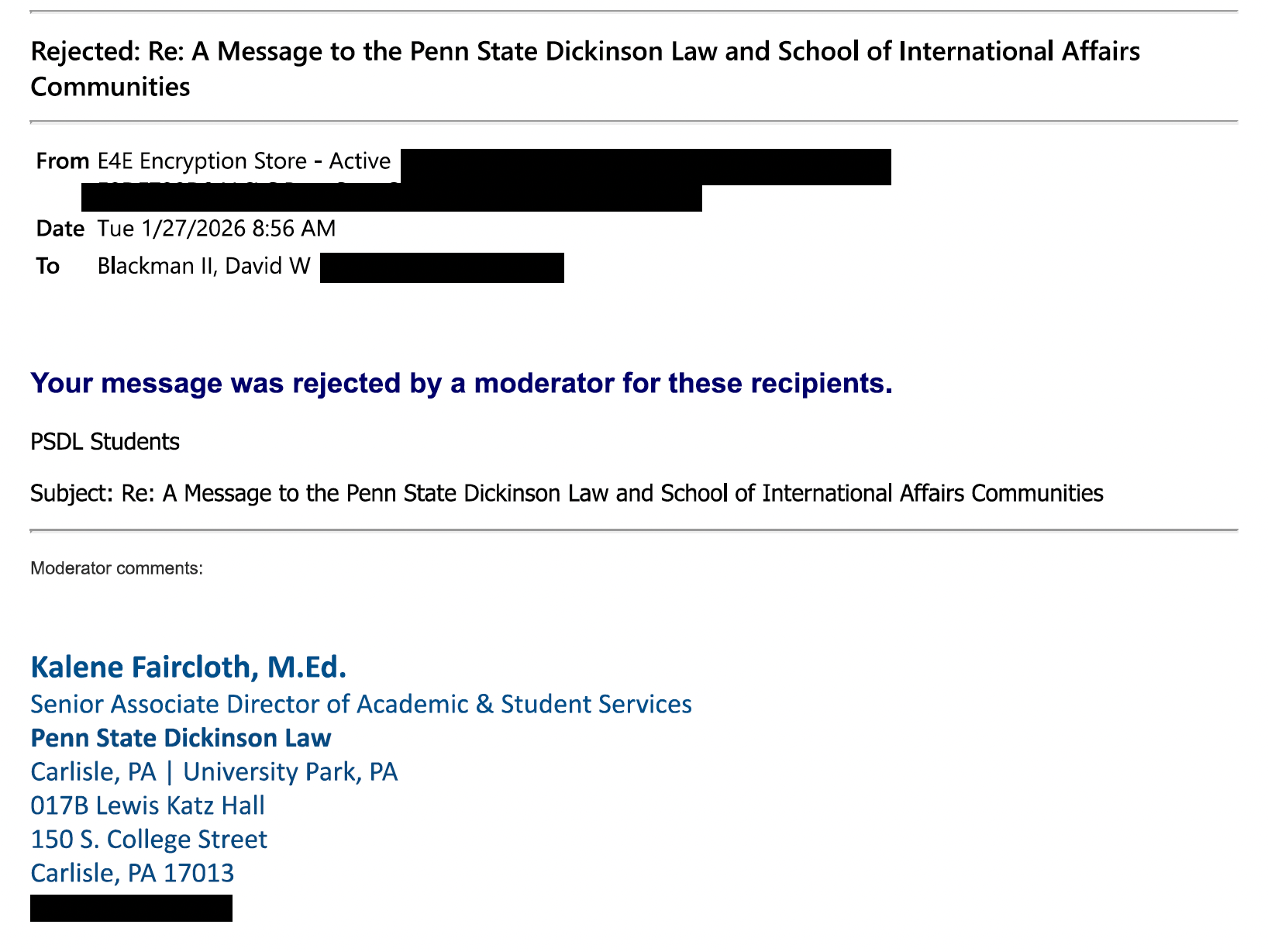
But when Blackman attempted to send the email, he was notified that a moderator for the listserv had blocked the message.
“Your message was rejected by a moderator for these recipients,” read the note from Kalene Faircloth, the law school’s senior associate director of academic and student services, who did not provide a rationale for the decision.
Fed up with the blatant act of censorship, Blackman filed a petition with the provost’s office demanding a “University-level audit of the Race and the Equal Protection of the Law … course and the concurrent administrative suppression of student speech.”
“Evidence demonstrates that Penn State Dickinson Law has established a ‘Closed Loop’ of state-enforced orthodoxy,” the seven-exhibit complaint read. “The Dean broadcasts the ideology (Exhibit D), the Curriculum compels students to advocate for it (Exhibit C), and Administrators censor legal dissent (Exhibit F).”
But rather than launch its own audit, Penn State punted the petition to Conway—the very dean who was the subject of the complaint. Conway, the executive director of Penn State’s Antiracist Development Institute, was also the driving force behind the creation of the anti-racism class, which she credits with exposing students to “the structure that supports the nation’s constitutional democracy.”
“REPL allows us to teach that through the lens of enslavement and racism,” she said in a press release about the course. “We use critical pedagogy to analyze how a governing system founded on a pledge of democratic ideals produces systemic inequity when legal, social, economic and civil obstacles limit liberty for those othered in society.”
The 2024 press release also noted that Conway attends every session of the class.
“It was an obvious conflict of interest,” Blackman said. He quoted a Latin saying, “nemo iudex in causa sua,” which means “no one should be a judge in their own case.”
On Feb. 26, the law school informed Blackman that he would not be excused from the class.
“We conclude that none of the remedial actions you seek to have the university take are required,” law professor Jud Mathews said, writing on behalf of a committee Conway had convened. “To graduate from the law school, you will need to complete all required courses, including REPL.”
That was the last straw. Blackman withdrew from the law school rather than complete the course, returning to Texas for a master’s degree in business administration.
Before he left, he gave Conway one final piece of his mind.
“As a former member of law enforcement in the Great State of Texas, I abhor everything this class teaches and will no longer be even a passive participant in such a farce,” Blackman wrote in an email on Feb. 27. “I am ‘free to think, and speak as I wish, not as the government or law school demands.'”
The full audio recordings of two class sessions are included below.