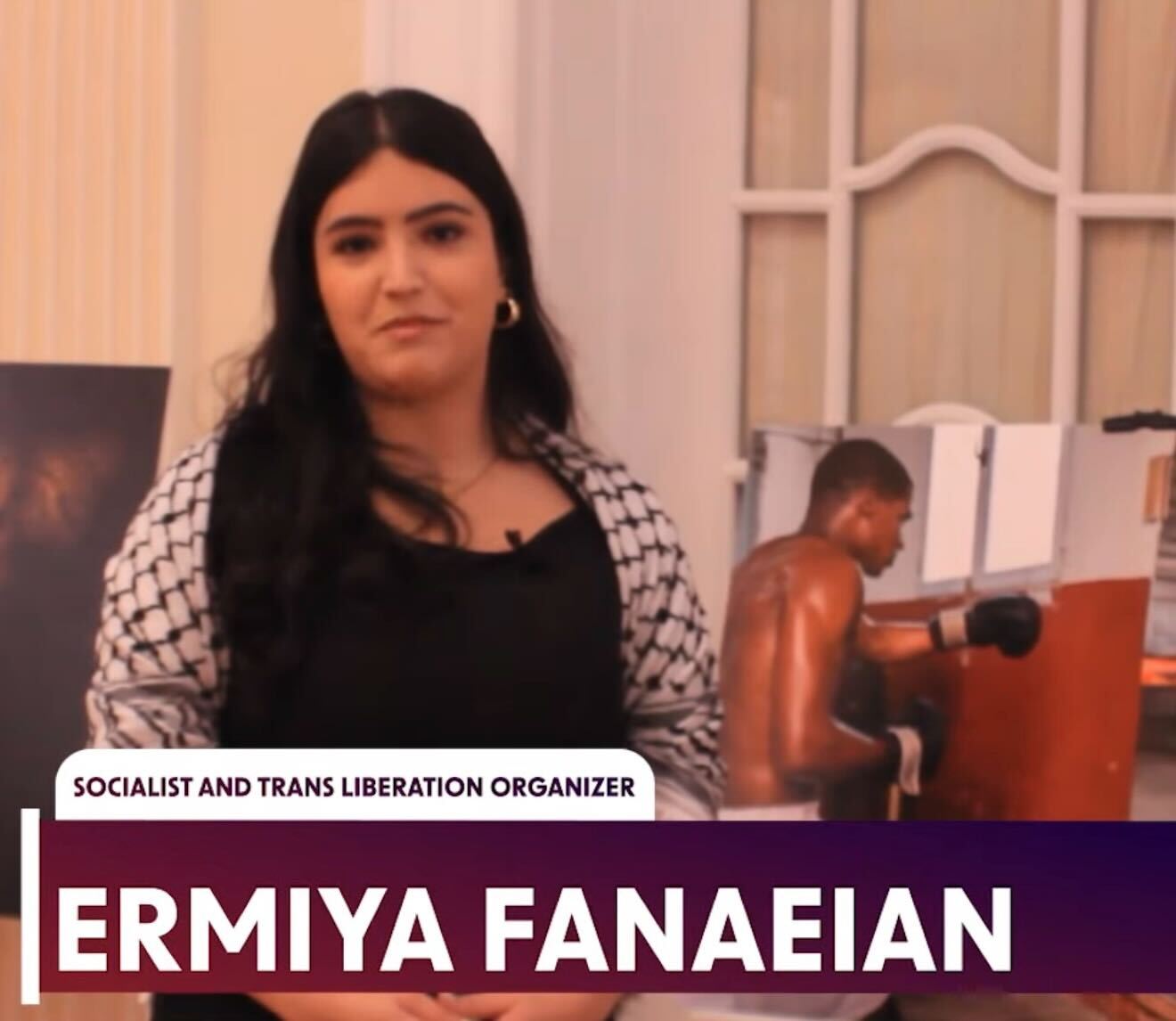
The Post quoted Ermiya Fanaeian as a Howard PhD candidate with family in Iran. It did not mention her work for ‘Armed Queers Salt Lake City,’ which included a visit to the Cuban embassy in DC to celebrate the life of Fidel Castro.
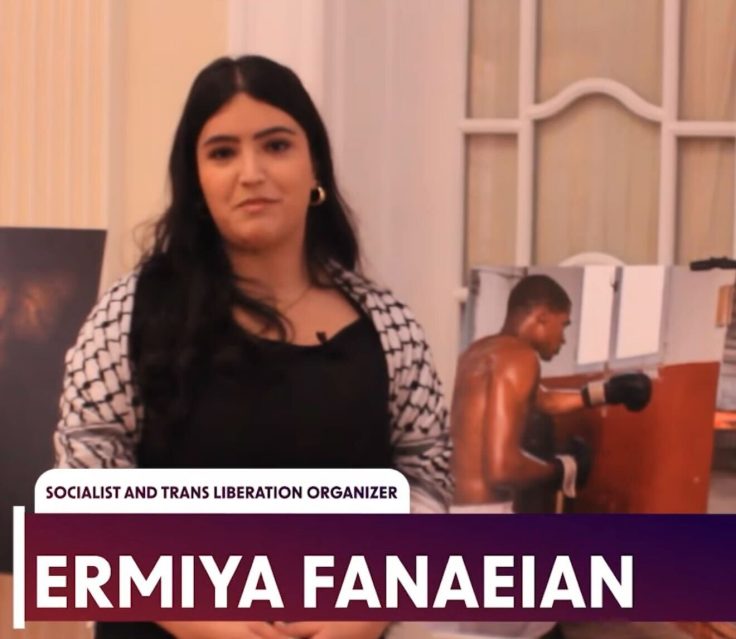
To Washington Post readers, Ermiya Fanaeian is a Howard University student who took to the streets to protest President Donald Trump’s military campaign against the Iranian regime out of fear for her relatives in Iran. The Post did not mention that Fanaeian is a self-described “socialist and trans liberation organizer” who founded a group of “Armed Queers” in Utah and has protested the United States and Israel long before Trump launched Operation Epic Fury.
The Post‘s Feb. 28 piece, headlined, “Outside White House, hundreds protest attack on Iran, urge end to conflict,” highlighted a protest that broke out near the White House hours after the strikes began. Its lede focused on Fanaeian, who “has lived in the United States since she was 1, but still has family in her home country of Iran.” As “word spread of attacks there by Israel and the U.S.,” Post reporters Jasmine Golden and Liam Scott wrote, Fanaeian “grew concerned about her relatives and other Iranians” and thus “decided to protest the military action.”
“It hits close to home,” Fanaeian told the Post, which identified Fanaeian as “a 25-year-old PhD candidate in political science at Howard University.” “I also know that the people in Iran are the ones who are going to experience the most, the biggest consequences from these attacks.”
Six paragraphs later, the Post included a piece of information that undermined its portrayal of Fanaeian as a spontaneous student protester: that Fanaeian is “an organizer with the Freedom Road Socialist Organization” (FRSO), a Marxist group that “helped coordinate the protest … with leaders from other groups,” including the Chinese Communist Party-tied activist group Code Pink. But Fanaeian’s far-left activism goes well beyond the FRSO—and went unmentioned in the Post‘s reporting.
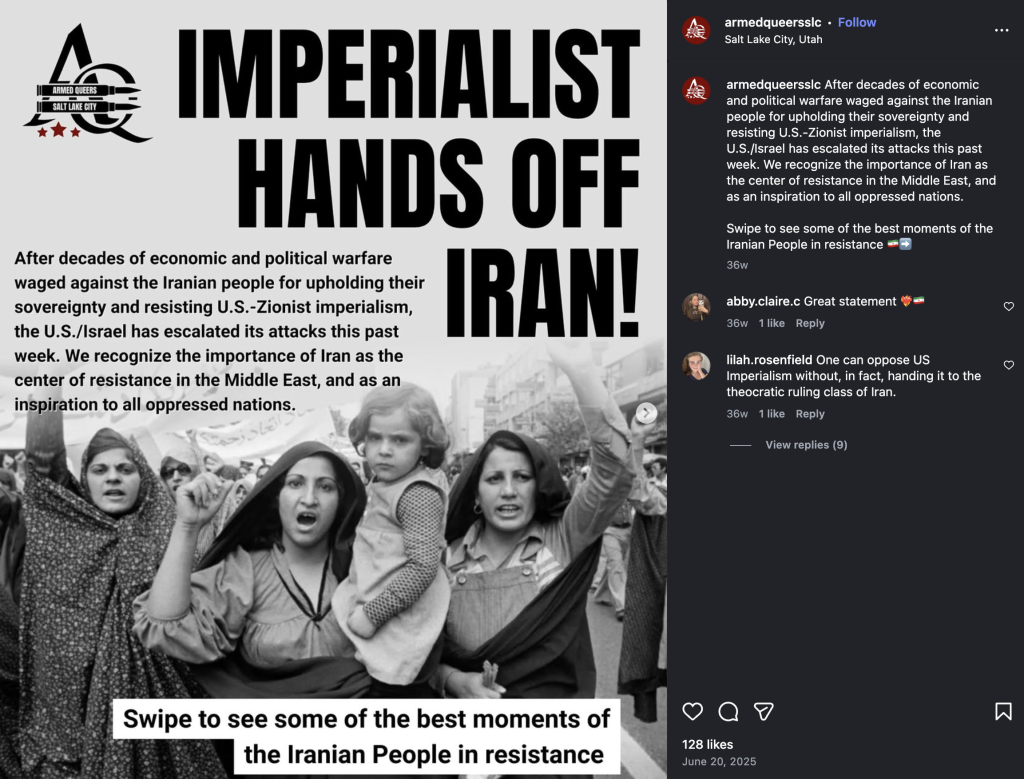
Before enrolling at Howard, Fanaeian was a well-known far-left activist in Utah, where she founded Armed Queers Salt Lake City, an “explicitly socialist and radical queer organization” that calls for the “armed and militant protection of queer and trans communities.” Though the group says its mission is rooted in self-defense, Fanaeian has endorsed political violence.
“Sometimes violence, protest, and really riots and those kinds of loud rebellions must take place for tangible change,” Fanaeian said in an interview she gave as a student at the University of Utah, according to the New York Post.
Both Fanaeian and Armed Queers Salt Lake City, meanwhile, have a long history of protesting both Israel and the United States.
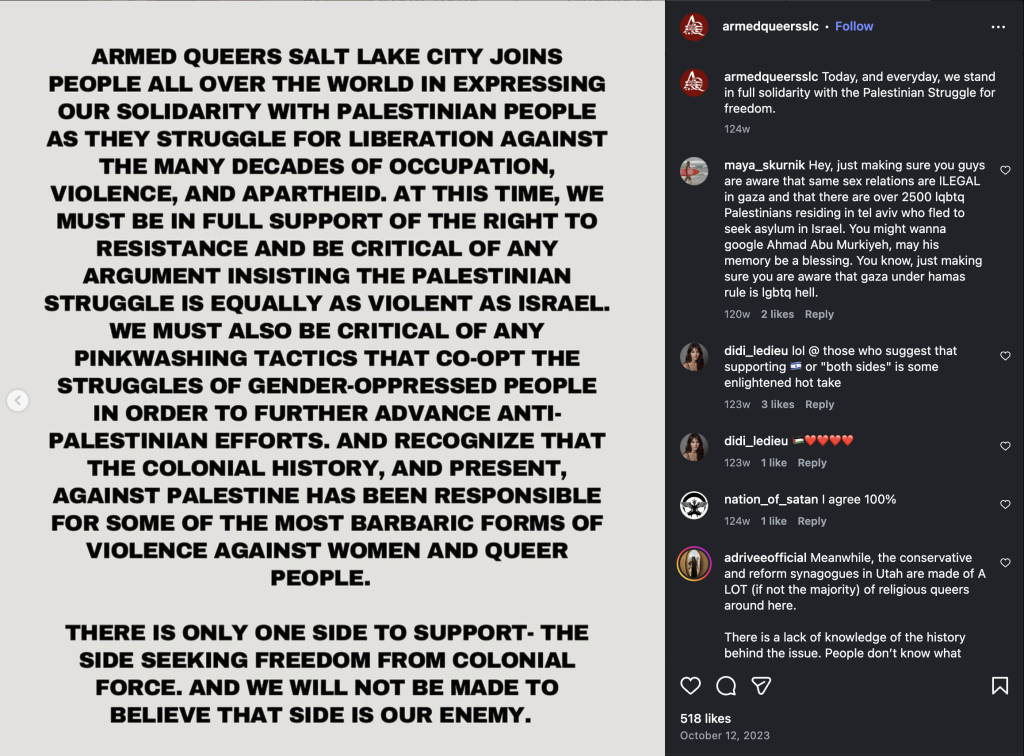
Five days after Hamas’s Oct. 7 terror attack, Armed Queers posted a statement voicing “full support of the right to resistance” and condemning “any argument insisting the Palestinian struggle is equally as violent as Israel.” The group also blamed anti-gay sentiments in Gaza—where homosexuality is illegal—on “the colonial history … against Palestine.”
“We must also be critical of any pinkwashing tactics that co-opt the struggles of gender-oppressed people in order to further advance anti-Palestinian efforts,” the statement read. “And recognize that the colonial history, and present, against Palestine has been responsible for some of the most barbaric forms of violence against women and queer people.”
“There is only one side to support—the side seeking freedom from colonial force. And we will not be made to believe that side is our enemy.”
Armed Queers went on to organize “Queers for Palestine” events discussing “Queer & Trans solidarity with Palestinian Liberation.” It called Kamala Harris “the candidate neoliberalism wants you to vote for.” And it identified Iran as “the center of resistance in the Middle East” during the 12-Day War between Israel and the Islamic Republic in 2025, lauding “young people and student organizations” for playing “a major role in the Iranian Revolution.” The group has not highlighted the role of students in the more recent protests against the Iranian regime, nor has it criticized the regime for killing tens of thousands of protesters.
Fanaeian’s affinity for dictators is not limited to the Iranian regime. In November, Fanaeian attended a “remembrace event” at the Cuban embassy in Washington, D.C., commemorating the ninth anniversary of Cuban dictator Fidel Castro’s death. In an Instagram post from the National Network on Cuba—a far-left activist group that calls for normalized relations between the United States and Cuba—Fanaeian “celebrated Fidel Castro’s life” and cited Cuba’s “revolutionary project” as a source of inspiration.
“So many of us have been inspired not just by Fidel but the entire revolutionary Cuban project in regards to how they have advanced health care for people, education for people, how they’ve advanced women and queer people’s rights all over the islands,” Fanaeian said. “I think every activist has the duty to … recognize the Cuban revolutionary project as a major inspiration for the kind of world that we want to move towards.” More than one million Cubans fled the island in the wake of the revolution due to political repression.
Many Iranian-Americans reacted differently to the strikes than Fanaeian. In New York City, hundreds marched to celebrate Ayatollah Ali Khamenei’s death. “I was crying and dancing the whole day yesterday after 50 days of torture,” New York University student Foujan Gharib, who came to the United States in 2023 after participating in anti-regime protests in Iran, told CBS News. “They killed so many innocent lives.” Civilians in Tehran were also filmed cheering and dancing as Iranian regime sites went up in flames on Saturday.
Fanaeian did not immediately respond to requests for comment.