“Have some caviar,” President Richard Nixon said, offering a tray with the chilled delicacy on it to Ray Price and me. “It’s from the Shah. We won’t be getting any more of that.”
President and Mrs. Nixon had invited Ray and me to join them and Julie and David Eisenhower for Thanksgiving dinner in the fall of 1979 at Casa Pacifica in San Clemente, California. I had joined Ray on the former president’s small editorial staff the previous fall and our work on Nixon’s second book since his resignation, The Real War, was nearing completion. The Nixons were readying to leave California for New York City.
Much of the previous fall and winter had been spent researching and writing what RN called his cri de coeur, “addressed not only to our political leaders but to leaders in all walks of life —to take hold before it is too late, and to marshal America’s strengths so as to ensure its survival.”
Nixon’s writing process was intensely iterative. Dozens of drafts of every page, with corrections, additions and deletions appended to every version circulating between we three in San Clemente, Todd Leventhal in D.C., along with the regular input of some giants in the field of national security — Ambassador Robert Ellsworth, General Vernon Walters, Professor William Van Cleave of USC., and the soon-to-be Secretary of the Navy John Lehman. A near final draft was carried to Pat Buchanan in McLean, Virginia, and returned the next day with the same precision and sharpening that Buchanan had, with Ray and William Safire, brought to Nixon’s foreign policy speeches throughout his presidency.
Nixon’s first book after his resignation, RN, looked backwards. Once it was done, Nixon only looked forward. The Real War is at least the equal of any of his 10 books and it was a comprehensive account of his world view. The Soviet Union loomed at the end of the Carter presidency as America’s most powerful adversary. But among the book’s through lines is Iran —not surprising given that its writing occurred in parallel to the events of 1978-1979. In those few months Iran plunged first into unrest, then revolution in 1978, regime change in 1979, and then the long hostage crisis which had begun only weeks before our Thanksgiving dinner.
“Iran has been plunged into bloody chaos and turned overnight from a bastion of Western strength to a cauldron of virulent anti-Westernism, its oil treasures lying provocatively exposed to lustful Russian eyes,” Nixon wrote on page 3 of The Real War.
Near the end of the book, the former president reflected on his visit to the exiled Shah in Cuernavaca Mexico in July 1979. The two deposed leaders had known each other for more than 40 years. Nixon had first met Reza Pahlavi in 1953, visited him often during Nixon’s wilderness years in the 1960s, and exchanged state visits after Nixon won through the turmoil of 1968 to gain the White House in 1969. It did not surprise that the exiled president — San Clemente was for six years the Elba of America — visited the exiled Shah in Mexico in the summer of 1979 or that Nixon would attend the Shah’s funeral in Cairo, Egypt, on July 30, 1980. Nixon was the only major American representative and the only high-ranking dignitary from the West in attendance. Nixon did not forget friends. He would return to Egypt on October 10, 1981, as part of America’s official delegation to the funeral of the assassinated Anwar Sadat, a delegation led by Secretary of State Alexander Haig and which included former Presidents Jimmy Carter, Gerald Ford, and Richard Nixon. President Reagan asked the former presidents to represent America’s long friendship with Egypt and to signal that ancient kingdom could count on America in its moment of peril.
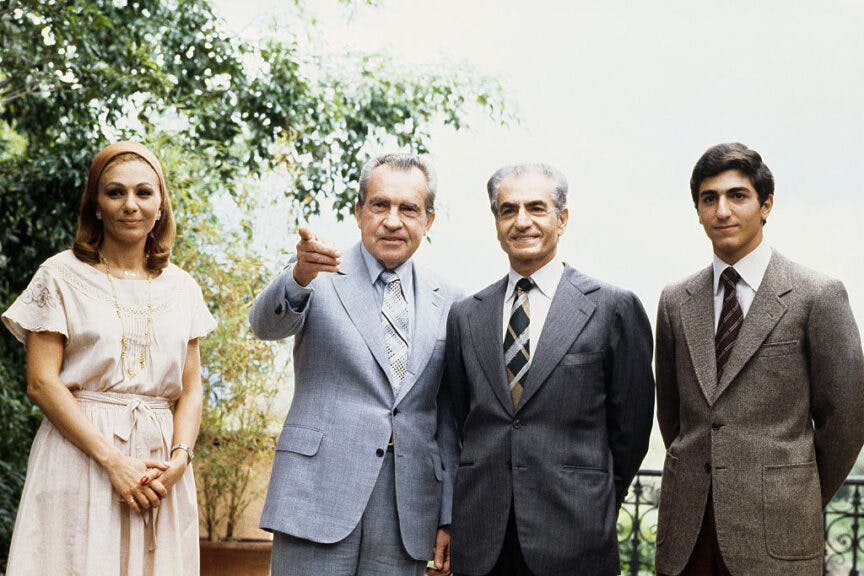
Richard Nixon meets Shah of Iran Mohammed Reza Pahlavi, his wife Farah Diba, and their son Prince Reza Pahlavi, 19, at a country club in Cuernavaca. (Photo by michael norcia/Sygma via Getty Images)
In the fall of 1978, the president, Ray, and I would often watch network news in the president’s office overlooking the Pacific, reports of the growing unrest in Iran. The near daily bulletins and broadcasts intensified as the Iranian Revolution gathered force and the Shah was obliged to abdicate and leave his country on January 19, 1979. The ominous-looking Ayatollah Khomeini returned to Iran from his exile in France on February 1. The Revolution soon began to eat its own as the mullahs consolidated power, established the Islamic Revolutionary Guards Corps to protect the clerics, and began a campaign of assassination and terror that spanned the globe.
The young adults of Iran were part of the 1978-1979 revolution, Nixon wrote in the book that this age cohort included “particularly those who had gone to school in the United States…”
They had “joined [the Shah’s] opponents and insisted he abdicate so that democracy and human rights, American style,” Nixon continued, believing those rights “could come immediately to Iran.”
“Instead of rights, they got Islamic dictatorship.”
Much earlier in The Real War, Nixon had expressed in text what he would often exclaim out loud in the old “Western White House” complex on the U.S. base adjacent to Casa Pacifica, sometimes rising from his chair or couch which faced the office’s one television, raising his hands in disgust and disbelief at what the networks were showing. Nixon knew the scale of the disaster unfolding before our eyes.
“The downfall of the Shah was a stunningly ominous event for the remaining monarchs of the Gulf as well as for the countries of the industrial west,” was how he reduced his vast frustration with President Carter into words. “The Shah provided the muscle that protected the rich but vulnerable Saudis,” among the many strategic advantages Iran brought the West.
As a 23-year-old, the lessons I learned watching RN watch the Iranian Revolution and then write about it were clear and remain clear and true. The world is a hard and dangerous place, and even the mighty United States has formidable enemies and needs stalwart friends to help keep Americans and their interests safe. The realities of the world had not changed since Thucydides wrote. Nixon was a walking encyclopedia of history, a statesman of the first rank on issues of national security. He came to office with more than a half million American soldiers deployed in Vietnam. He knew the cost of war. He knew the cost of losing them and of losing allies. He tried to convey the most important lessons he had learned from success and failure on the international stage.
“We must never set higher standards of conduct for our friends than for our enemies,” Nixon inserted into one of his reflections on the Iranian Revolution.
“Above all, in the future we must stand by our friends or we will soon find that we have none.”
The conclusion that continues to resonate today, 46 years after The Real War published: “The tragedy of Iran is a case history of what happens when the United States fails to distinguish between authoritarian and totalitarian regimes, between those that provide some human rights and those that deny all, between those who are our staunch allies and friends and those who are our potential enemies”
What most Americans do not recall about the Iran of the Shah, included in The Real War, was that “[i]n less than twenty years he had brought Iran into the twentieth century,” that the Shah had massive land reform which distributed wealth and power from the clerics, and “[i]n what amounted to a revolutionary change in Moslem Iran, women were given full political rights over the bitter opposition of traditional Islamic leaders.”
Now as the battle rages throughout the Middle East, the United States is locked in open battle with a formidable foe that has chosen to be at war with us and our allies Israel and the Gulf states rather than agree to conduct itself as a non-nuclear civilized state and not a radical theocracy bent on exporting the revolution it was built upon.
It has been nearly 50 years since I watched and wrote about Iran with RN. Nothing has changed about the strategic centrality of the ancient state and civilization in Iran. Much has changed in America. President Trump conducts national security affairs with the clear-eyed realism that Nixon embodied. It is no surprise that 45-47 is acting as 37 almost certainly would have advised him to: Offer peace, but if it comes to blows, strike hard, fast, and relentlessly to achieve what was rejected.
* * *
Hugh Hewitt is the host of “The Hugh Hewitt Show,” heard weekday afternoons from 3 PM to 6 PM ET on the Salem Radio Network. Hewitt is also a Fox News contributor and columnist.
The views expressed in this piece are those of the author and do not necessarily represent those of The Daily Wire.