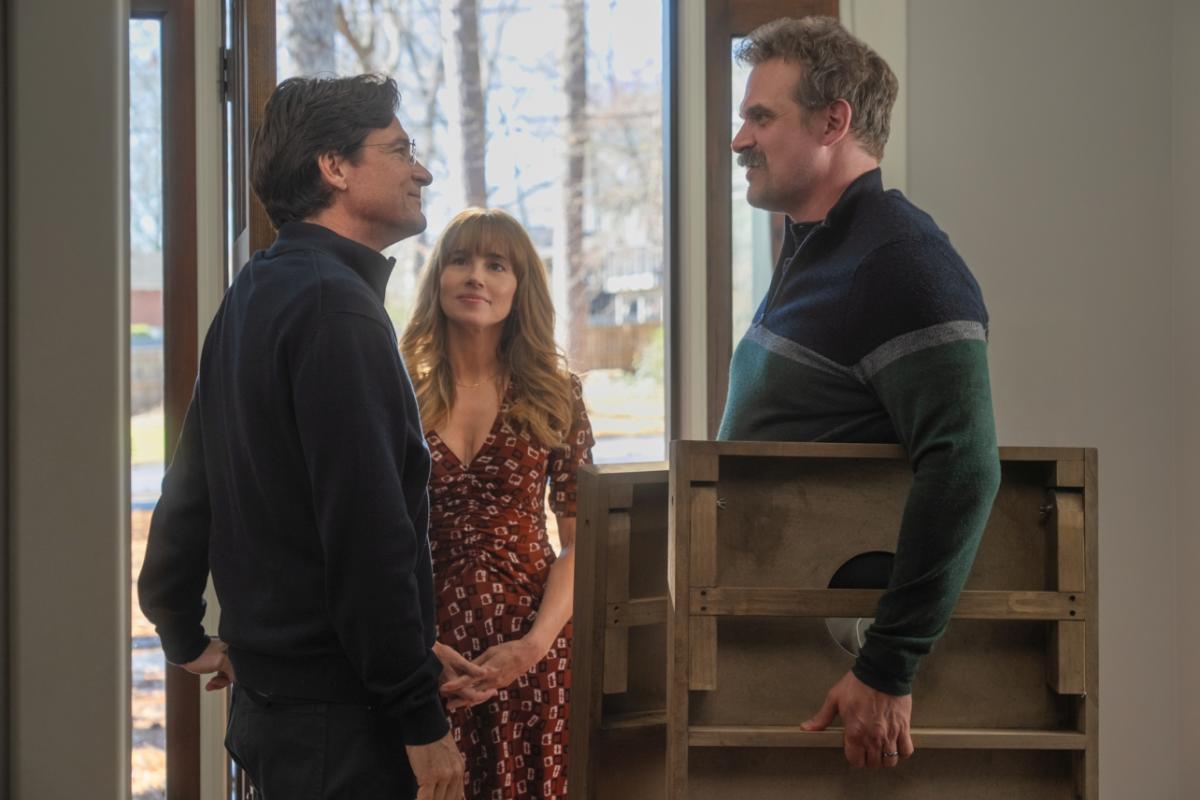
Sometimes shows start out weird but intriguing, and we just have to go to a second episode to get more context. That’s what happened with DTF St. Louis, a new dark comedy airing on HBO Max.
Opening Shot: “2018.” A man on a recumbent bike says goodbye to his wife and daughters and pedals to work. Elsewhere, a man and his stepson are doing a trust exercise.
The Gist: Clark Forrest (Jason Bateman) is a weatherman at a local St. Louis television station; Floyd Smernitch (David Harbour) works as a freelance ASL interpreter, and he’s trying to bond with his teenage stepson Richard (Arlan Ruf). The two of them meet when Floyd works as an ASL interpreter during a remote report Clark gives during a massive storm. Floyd pulls Clark back, keeping him from being impaled by a flying stop sign. Inside a convenience store, they become fast friends. Floyd even tells Clark about his Peyronie’s disease (look it up).
Two weeks later, Floyd and his wife Carol (Linda Cardellini) are hosting a cornhole party/cookout, and Clark is there with his wife Eimy (Wynn Everett). However, he certainly seems to be taken by Carol, and the feeling seems to be returned. After a montage of Floyd and Clark bonding, we see the Smernitches come over the Forrests’ house.
There, Floyd tells Clark that since Carol has started umpiring Little League games, all he can envision is his wife in umpiring gear, completely turning him off. Clark tells Floyd about an app called “DTF St. Louis,” where married people discreetly match and meet for sex (“DTF” means exactly what you think it does).
Eight weeks later, at a poolhouse named for St. Louis native Kevin Kline, Floyd is found dead. It looks like he died of a heart attack, but a can of Bloody Mary drink next to him indicates something suspicious. Since the poolhouse is in suburban Twyla, the local PD’s Special Crimes detective, Jodie Plumb (Joy Sunday) is first on the scene, and is annoyed when Donoghue Homer (Richard Jenkins) a homicide detective from the county sheriff’s department arrives, takes over the investigation, and jumps to lots of conclusions, including the reasons why there is an old Playgirl centerfold next to Floyd’s body, with the face scratched out.
When Plumb sees CCTV footage of a recumbent bike outside the poolhouse, Homer confirms that the only two of those bikes sold by a local store were sold to Clark. Between the footage and the texts between Clark and Carol that are on Clark’s phone, analyzed by the sheriff’s department, it doesn’t look good for Clark.
What Shows Will It Remind You Of? Created by Steven Conrad (Patriot, Perpetual Grace LTD), DTF St. Louis has a similar told-through-flashbacks feel as The Affair, though it’s a more darkly comedic show.
Our Take: Let’s get this out of the way: The first episode of DTF St. Louis is weird. It’s not only disjointed, story-wise, but both Clark and Floyd are such awkward, beta-male stereotypes in their scenes together that it made us wonder exactly what this story was all about.
But halfway through the first episode, things kick into gear when Floyd is found dead in the poolhouse. And even though detectives Plumb and Homer are constantly arguing as they look into Floyd’s death, things start to coalesce around Clark, and then we realize that what we saw earlier was only pieces of the story of Clark, Floyd and Carol.
The second episode lays things out better, as Clark and Carol talk to Homer and Plumb about their affair. Of course, when we have non-linear storytelling, there’s a huge risk that the back and forth and withholding of information will annoy viewers rather than draw them in. But with the second episode, the disjointed nature of the first one has more context. In essence, the first half-hour of the first episode is more of an overview of the story Clark and Floyd’s friendship, with the idea that the details that get filled in later are surprising at times and explain things at others.
It also helps that Bateman does well playing Clark as a pathetic guy who knows he’s pathetic, and Harbour does well playing Floyd as a pathetic guy who’s trying to be less pathetic. For her part, Cardellini does her usual job of being able to switch on a dime from cold and calculating to warm to sexy, depending on what her character needs to manipulate the situation.
We wish we could have engaged more with Clark’s family, especially Wynn Everett as Eimy, but it feels like they’re purposely written as being personality-free in order for audiences to buy into Clark stepping out on them, at least at first.
But what we also hope is that all of this back and forth leads to a satisfying conclusion that not only explains what happened to Floyd, but who was the most responsible.
Performance Worth Watching: Harbour is the standout among the show’s three big-name stars, because pretty much everyone can identify with the paunchy Floyd struggling to recapture his youthful glory. There’s a scene in the second episode where we see Floyd in a hip hop dancing class that shows that he can move pretty well.
Sex And Skin: None in the first episode, a little bit in the second.
Parting Shot: We flash back to Clark and Floyd working out together, and Floyd signs something shocking to Clark.
Sleeper Star: Two other cast members: Peter Sarsgaard and Chris Perfetti, aren’t in the first episode, but we’re looking forward to seeing both.
Most Pilot-y Line: Plumb and Homer talk about Clark’s recumbent bike. “You see them sometimes… not often,” she tells him. “It’s like a nerd thing?” he asks.
Our Call: STREAM IT. DTF St. Louis is definitely a little weird at the start, but viewers’ patience will be rewarded with a quirky but interesting mystery starting in Episode 2.
Joel Keller (@joelkeller) writes about food, entertainment, parenting and tech, but he doesn’t kid himself: he’s a TV junkie. His writing has appeared in the New York Times, Slate, Salon, RollingStone.com, VanityFair.com, Fast Company and elsewhere.