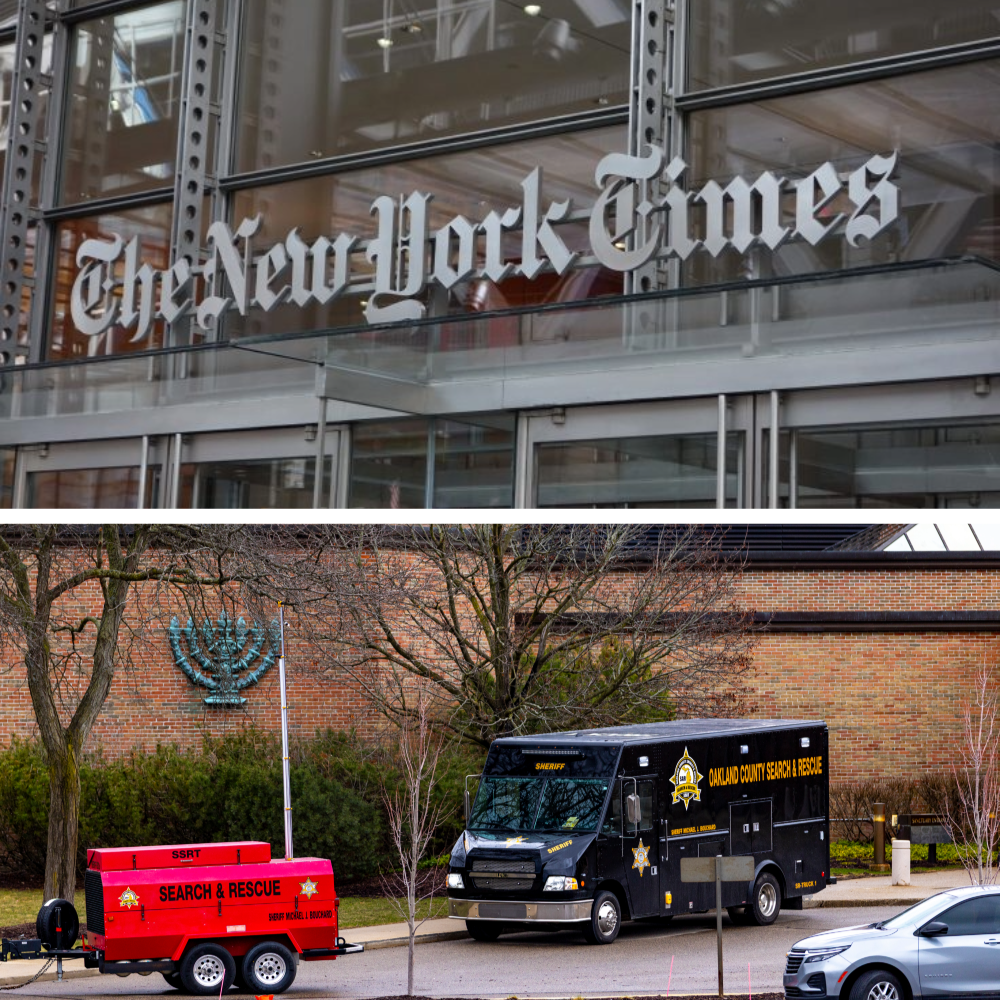
The New York Times is drawing bipartisan condemnation for its coverage of an attack on a synagogue in Michigan that critics faulted for seeming to justify the attack.
“Synagogue Attacker Lost Family Members in Lebanon Airstrike” was the headline of a print Times news article, published Saturday, March 14, 2026. In print, the Times failed to mention that, according to the Israeli government, at least one of the “family members” was a Hezbollah terrorist. Online, the Times quoted an anonymous Lebanese official who said the family members were not Hezbollah members.
That may seem like a subtle detail, but it generates a totally different storyline. The Times headline and storyline basically conveys “grieving guy takes revenge for innocent family members killed by Israel.” The other would be more like, “would-be murderer in Michigan was a terrorist fanatic like his brother in Lebanon.”
Don’t just take it from me: The State Department’s special envoy to monitor and combat anti-Semitism during the Biden administration, Ambassador Deborah Lipstadt, wrote that the Times headline “suggests that because he lost family members in Lebanon trying to kill Jewish children is sorta ok.”
The Times eventually published online a March 15, 2026, article reporting the Israel Defense Forces disclosure that, as the IDF put it in a social media post, “INTELLIGENCE REVEALS: BROTHER OF TERRORIST BEHIND U.S. SYNAGOGUE ATTACK WAS A HEZBOLLAH TERRORIST.” As the IDF put it, “Hezbollah commander Ibrahim Muhammad Ghazali was responsible for managing weapons operations within a specialized branch of the Badr Unit. The unit is responsible for launching hundreds of rockets toward Israeli civilians throughout the war. His brother, Ayman Muhammad Ghazali, carried out the terror attack in Michigan this past Thursday. Ibrahim was eliminated in an IAF strike on a Hezbollah military structure last week.”
That follow-up Times article doesn’t use the word “terrorist” or “terror,” as is typical with Times practice of inaccurately conveying what the Israeli government is saying, as if Times readers can’t be trusted with the language. The same Times article reports, “A Hezbollah official, speaking on condition of anonymity to talk to the media, denied that Ibrahim or his family were affiliated with the group.” The U.S. government has long designated Hezbollah as a terrorist group.
In the attack, Ayman Mohamad Ghazali reportedly drove a pickup truck full of explosives into Temple Israel in West Bloomfield, Michigan, while preschool with 140 students was in session. Eventually he killed himself during a gunfight with security guards.
A New York Times spokeswoman, Nicole Taylor, told the Washington Free Beacon, “We’ve published dozens of stories and blog posts, providing readers with accurate information as we learn and confirm more facts. In any breaking news event, we update our coverage and headlines as a story develops, or where initial reporting was incomplete, as was the case with our early report that relatives of the synagogue attacker were not affiliated with Hezbollah. We also updated a headline and story on the attacker to better capture the violence of the act, along with what our reporters learned about his life.”
The “Synagogue Attacker Lost Family Members” story came on the heels of another Times headline about the same attack that prompted widespread outrage.
“Temple Israel was founded in 1941, Dedicated to the Formation of a Jewish State,” was one online Times headline in the aftermath of the attack. “Extremely dangerous and disgraceful. The @nytimes continues to spew antisemitic propaganda,” wrote Rep. Elise Stefanik, a Republican of New York.
A professor at MIT, Ezra Zuckerman Sivan, declared himself “Infuriated at the NYT’s Antisemitism-fomenting Clickbait.” He called the headline “reprehensible” and said it “may finally push me out the door as a New York Times subscriber” after decades.
The House Committee on Education & Workforce posted from its official account: “This is the kind of headline that emboldens antisemites … A terrorist attacked a synagogue with a preschool and targeted innocent people in an antisemitic attack. When hatred rears its ugly head, pay attention.”
The Times changed the headline over that article so that it now reads, “Temple Israel Is One of the Largest Reform Temples in the U.S.” A professor at Wayne State University who was quoted in the Times article, Howard Lupovitch, told the Washington Free Beacon, “the original headline focused on one part of a longer, wide-ranging conversation and made it the centerpiece of what I said. I was glad they changed it.”
Dunking on online headlines on a breaking news story is the sort of thing you can make a case for refraining from doing, but at this point whatever credibility the New York Times had is so thoroughly eroded that for at least some readers, patience and trust are wearing thin, or are gone entirely.
Russ Roberts, host of the EconTalk podcast and president of Shalem College in Jerusalem, whose sensibility is pretty sober, had this reaction to the New York Times obituary declaring the catastrophic predictions of The Population Bomb author Paul Ehrlich as “premature”—rather than just plain wrong: “Don’t give the NYT your money. Don’t subscribe. Don’t play their puzzles. Don’t pay for The Athletic. We can return if they return someday to their purported purpose of informing and not just proselytizing. (And yes I know about Walter Duranty. But what was once occasional is now the mode.)”
In this case it’s not clear whether the problem is with the Times in particular or with the mainstream media in general. The Wall Street Journal ran a similar story in its Saturday paper, headlined “Synagogue Attacker Lost Family in Lebanon,” also failing to mention the Hezbollah connection of the “family.” The two authors of that story did not reply to email queries about the omission from the Free Beacon. As is frequently the case at the Wall Street Journal, the online commenters were having none of it: “Well the WSJ ‘news’ section may have reached a new low. This article appears to be trying to excuse the attack on a synagogue in Michigan because of civilian casualties in a war on the other side of the world. Absolutely disgusting,” wrote one reader, Ian K. Another reader, Joshua Klein, wrote, “And that is justification for targeting innocent Jewish preschoolers in what universe? Shame on WSJ framing this as justification for a heinous act.”
At least some news organizations were more timely than the Times or the Journal in reporting the Lebanese Hezbollah angle. NBC reported Friday afternoon that “the strike killed two of his brothers, who were known to be members of Hezbollah, and his niece and nephew, an official told NBC News.” CBS also reported, “A freelance journalist working for CBS News in Lebanon learned from sources there the two brothers were both members of a Hezbollah rocket unit in southern Lebanon.”
The Times has been boasting that it now employs 2,300 journalists, doubled from 10 years ago, so at least over there, whatever the problem is, it’s not a resource issue in terms of having enough bodies to throw at a story.