New York City mayor Zohran Mamdani (D.) is sinking a quarter of a billion dollars into his new Office of Community Safety—which is intended to deploy social workers to respond to hate crimes, mental health crises, and other events typically handled by police—as the city faces a historic budget crisis.
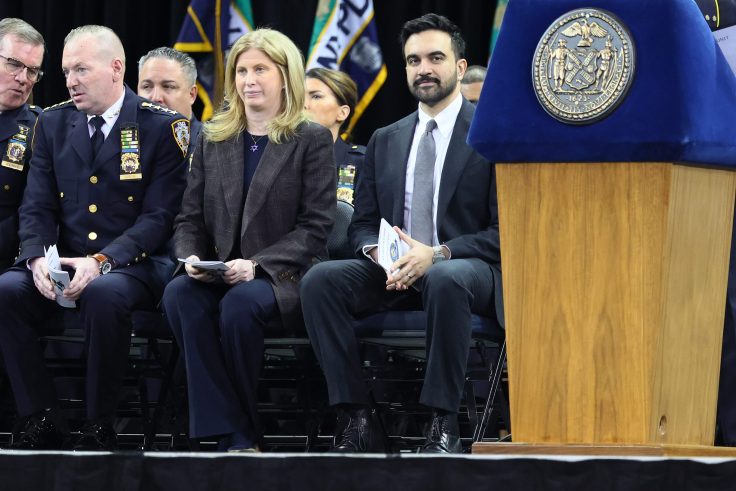
Mamdani established the office in a March 19 executive order and revealed in a signing ceremony on the same day that it would begin with a $260 million budget. While Mamdani moved those funds from existing city programs to his new office, he pledged to “add more funding down the line,” according to the New York Times. During his mayoral campaign, Mamdani pledged to fund the office to the tune of $1.1 billion.
“It’s remarkable that Mayor Mamdani is supposedly grappling with a historic budget gap of $5.4 billion through fiscal 2027—despite the absence of a recession or financial crisis—yet has managed to include $260 million for a new office with only two staffers,” John Ketcham, a senior fellow at the Manhattan Institute, told the Washington Free Beacon.
“At $260 million, the office represents roughly 5 percent of Mamdani’s budget gap, more than the approximately $200 million in savings the mayor touted last week,” Ketcham went on. “Many of those savings are speculative and may never materialize. The mayor has not announced a hiring pause, a step any serious effort to reduce spending would include, as personnel costs make up the largest share of the city budget.”
Mamdani’s proposed $127 billion budget has led multiple credit rating agencies to issue warnings about the city’s long-term financial prospects, and though the mayor pledged to find $1.7 billion in cuts, he has only announced $200 million so far.
The mayor is legally required to balance the city’s budget by July 1, the date at which the city council will adopt the financial plan for the upcoming fiscal year. The mayor initially proposed a 9.5 percent increase in city property taxes, a move he presented as an ultimatum: Either New York governor Kathy Hochul (D.) would raise income taxes on the state’s wealthiest residents—which would require her to abandon her campaign promise not to do so—or Mamdani would hike property taxes. By Wednesday, the New York Times reported that the mayor had backed away from that proposal after swift backlash.
Representatives for Mamdani did not respond to a request for comment.
The nine-figure outlay for the Office of Community Safety has also raised eyebrows because it is unclear what the office will do in practice. Many critics pointed out that the executive order creating the office was thin on specifics.
“My immediate thoughts were, ‘This is the Temu version of what he had promised during the campaign,’ because he’s realizing day-by-day that he cannot make good on the majority of his campaign promises,” city councilwoman Joann Ariola (R.), who serves on the chamber’s public safety committee, said of Mamdani’s executive order.
The language in the executive order places the Office of Crime Victim Services, Office for Neighborhood Safety and the Prevention of Gun Violence, Office to End Domestic and Gender-Based Violence, Office for the Prevention of Hate Crimes, and Office of Community Mental Health under the operational control of the new agency. The new office has supervisory powers over these agencies, but the text of the executive order does not offer many more specifics.
Mamdani named Renita Francois, who worked for a Soros-backed nonprofit that pushed defunding police departments and abolishing prisons, as deputy mayor for community safety. He added that he will soon appoint a commissioner to oversee the office.
Rafael Mangual, a fellow with the Manhattan Institute and member of the Council on Criminal Justice, said the vagueness of the executive order points toward the challenges Mamdani will face attempting to get his plans through.
“I think he’s starting to understand that there are real structural limits on what he’s going to be able to do in the way of shifting responsibility away from the NYPD,” Mangual told the Free Beacon. “And so I think the vagueness owes to his own sort of reticence to make commitments that he’s not going to be able to keep.”
The Office of Community Safety is intended as a precursor to a larger Department of Community Safety, which Mamdani described in his campaign platform and which would have a total yearly budget of $1.1 billion—with more than $600 million coming from undefined “transfers of existing programs.”
He included proposals to replace police with “crisis responders” in “mental health” cases, but the memo—as with the executive order—did not define such cases. As the Free Beacon reported during the campaign, Mamdani said during a 2020 podcast appearance that a list of “different situations that would be far better handled by people trained to deal with those specific situations, as opposed to an individual with a gun,” includes “domestic violence.”
The overview on his campaign website also explained that Mamdani would fight hate crimes through creating “restorative justice processes,” instituting “community-based bystander training,” and enlisting “mental health navigators.” Several hate crime survivors told the Free Beacon in August that having anyone other than police respond to those crimes would have serious consequences.
John Chell, who retired as the highest-ranking uniformed officer in the NYPD in 2025, told the Free Beacon that the full scope of Mamdani’s plan—vague as it is—is unworkable.
“Look, in a perfect world, if you’re saying social workers and medical assistants or medical doctors can lighten the load, if you will, of the police department and get people the help they need, that’s phenomenal, isn’t it?” he said. “But who’s going to protect these people? It’s going to take one incident, and it’s going to be a massive problem.”
Mamdani sought to play down his history of radical statements about the NYPD—an organization he called to defund and branded as “racist, anti-queer & a major threat to public safety”—during his campaign. He said in July after a mass shooting in Midtown Manhattan that his “statements in 2020 were ones made amidst a frustration that many New Yorkers held at the murder of George Floyd,” adding that he was “not running to defund the police.” After walking back his old positions, though, Mamdani named supporters of the Defund the Police movement to his transition team and his administration, including his director of appointments.
Even if Mamdani does intend to “chip away at the NYPD,” Mangual told the Free Beacon, he will likely be unable to do so without placing an even greater strain on the city’s budget.
“What we’re talking about is an expansion of pre-existing programs that are very limited in scope and capacity,” he said. “Without a massive increase in funding, there’s no reason to think that the NYPD is going to be doing significantly less than what it’s doing now.”
Though structural forces may prevent Mamdani from completing a full transition of responsibilities away from the NYPD, Councilwoman Vickie Paladino (R.) told the Free Beacon she does not expect him to stop trying.
“While it’s true that this executive order might not be everything he promised his radical base on the campaign trail, it nonetheless represents the beginning of what will inevitably be a relentless grind by the left to make the NYPD subservient to the activists who will run this department,” Paladino said.