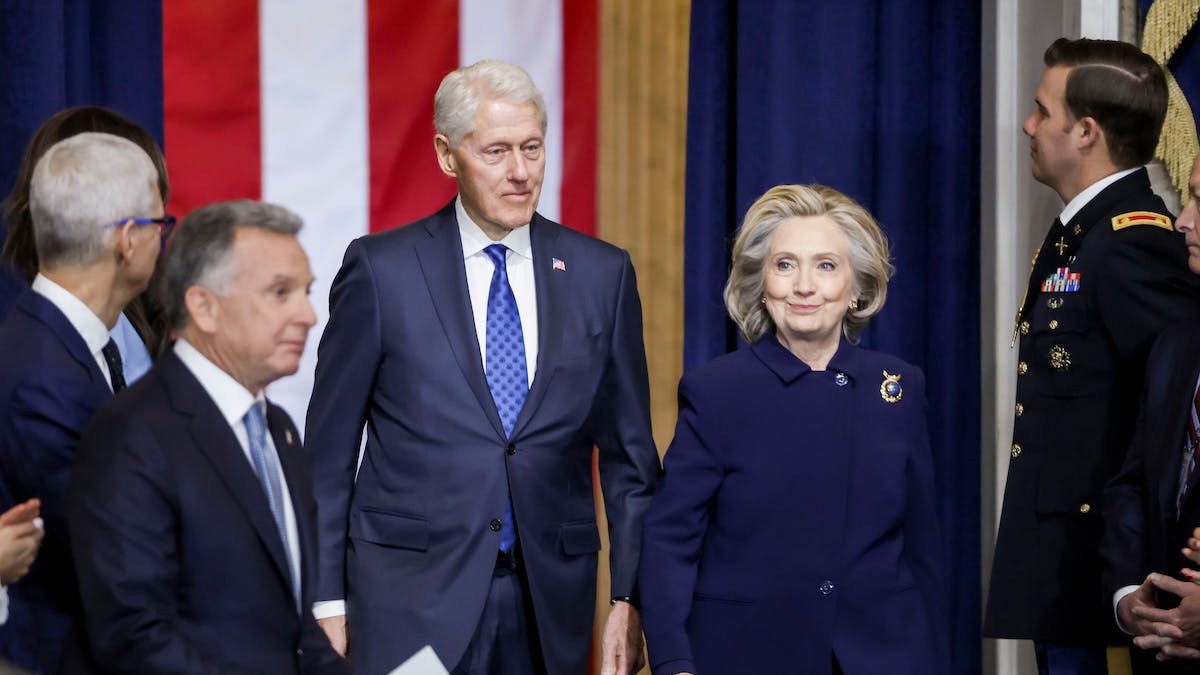
Twice-failed presidential candidate Hillary Clinton delivered an op-ed for The New York Times on Thursday, offering her advice to Democrats on how to win against “brain-dead” Republicans in the future.
Clinton, who served as Secretary of State after losing the 2012 Democratic primary to former President Barack Obama, criticized Republicans generally — and President Donald Trump specifically — for requesting an increase to the military budget, complaining that the administration was ignoring working families to do so.
Questioning those concerned with America’s falling birth rate — which is well below the replacement rate and predicts an imminent population drop-off — she added, “Their answer is too often nostalgia and misogyny: If we could turn back the clock to a time when women didn’t work (and knew their place), the economy would thrive and families would flourish. This is substantively and politically brain-dead.”
Clinton then proceeded to tick off a list of priorities she believed Democrats should focus on if they wanted to succeed in the future — but most of her proposed solutions were either already well-entrenched in the Democratic Party’s platform or had already been tried, with varying degrees of success or failure, by one or both parties.
One such solution, according to Clinton, was an increase in child tax credits — specifically refundable tax credits. The IRS describes a refundable tax credit as “a credit you can get as a refund even if you don’t owe any tax.” The end result of a refundable child tax credit would be a redistribution of wealth based on number of dependents — and in past years, this has been accomplished through the Earned Income Credit.
Another solution — one that has already been embraced by both parties to some degree — is paid family leave. Clinton also focused on early education, childcare, and health care — all of which have been key elements of her party’s platform for years, if not decades. The key driver in all of those suggestions was her insistence that those programs be delivered at the national level rather than by individual employers looking for a competitive advantage or even by more local jurisdictions where the specific needs of the people in that area could be addressed.
Her final suggestion was a national baseline for artificial intelligence safeguards — again, something that both parties and the White House have expressed an interest in exploring.