Outside of the Revolutionary War era, it would be hard to find another period in American history when Americans have been more reluctant to pay their taxes — and justifiably so. At this point it’s understandable if your eyes start to glaze over when you hear about yet another massive fraud scheme that’s been engineered by foreigners to steal millions of dollars’ worth of your money. We’re talking about billions of dollars in Medicaid fraud, in just the state of Minnesota alone, every year. Think about that for a second. In just one state, Medicaid fraud all by itself — which is enabled by insurance companies and the Democrat Party — accounts for billions of dollars in theft.
In response, the Trump administration has launched an “anti-fraud task force,” led by JD Vance, to prosecute some of the worst offenders. But the truth is, an anti-fraud task force can’t actually solve the problem. Playing whack-a-mole with fraudsters isn’t going to work — they’re too creative, and our system of taxpayer handouts is effectively based on the honor system. In order to understand what I mean, we’ll start with a fun little exercise, where we all play detective.
Watch this footage from an alleged armed robbery in Georgia, and try to identify what — if any — type of fraud might be occurring here.
Also, for your own amusement, watch very closely when they zoom in on the alleged “attack” on the store clerk.
Here it is:
Source: Law & Crime Network/YouTube.com
First of all, if you’re going to stage a robbery to steal $5,000 from the store, you’ve got to make it look more convincing than that. LeBron James would be embarrassed by the flop. For $5,000, you’ve got to make contact, at the very least. And it would probably be smart to have your accomplice leave the premises for a bit, instead of sticking around and pouring the cash all over the ground when the police show up.
But that’s all besides the point. The point is — if you were a detective assigned to this case, what are the possible motives you’d come up with? Besides the cash, what would someone named “Patel” possibly have to gain by staging a robbery like this?
To answer that question, we need to go back to a much different time in America — the year 2000. That was before we imported tens of millions of foreigners and transformed the entire country. By some estimates, 38% of all immigrants currently living in the United States arrived after 2010. And 21% arrived between 2000 and 2009.

Before all of that migration, America was a very high-trust society. And that’s why, in 2000, the Victims of Trafficking and Violence Protection Act passed the House and Senate with only one “no” vote. The entire House and Senate agreed on this legislation, and the only holdout was upset about the deficit — he didn’t actually object to the bill. So what did the legislation do? It created a new “U Visa,” which allows illegal immigrants in the United States to obtain legal status, as long as they’re the victim of a serious crime — including a violent assault.
At the time, no lawmaker — in either the House or the Senate — even considered the possibility that large numbers of foreigners would stage their own violent assaults, in order to qualify for this new “legal status.” But that’s exactly what’s happening at the moment in the United States.
This is a recent press release from the DOJ. Bear with me here as I try to read these names.
Eleven Indian nationals have been charged in connection with a conspiracy to carry out staged armed robberies of convenience stores for the purpose of allowing store clerks to falsely claim they were crime victims on immigration applications. The following defendants have been charged with one count of conspiracy to commit visa fraud: 1. Jitendrakumar Patel, Maheshkumar Patel, Sanjaykumar Patel, Dipikaben Patel, Rameshbhai Patel, Amitabahen Patel, Ronakkumar Patel, Sangitaben Patel, Minkesh Patel, Sonal Patel, and Mitul Patel.
Yes, every single one of them is named “Patel.” (Which incidentally, is the same name as the cashier in the video above, although to be clear, that particular Patel hasn’t been accused of visa fraud — he was supposedly after insurance money).
As for these 11 other Patels, according to the DOJ:
Rambhai Patel and his co-conspirators set up and carried out staged armed robberies of at least six convenience/liquor stores and fast food restaurants in Massachusetts and more elsewhere. It is alleged that the purpose of the staged robberies was to allow the clerks present to claim falsely that they were victims of a violent crime on an application for U non-immigration status.
As you might imagine, this kind of fraud is very difficult to detect. So we can assume this is happening constantly, all over the country. Unless these people are monumentally dumb, they won’t get caught. They’re taking advantage of laws that were passed when America was a very different place. And unless we repeal all of these laws, we’re going to see a lot more fake crimes, and a lot more fraud. Every other day, we’re learning about a new scam.
The New York Post, along with Nick Shirley, have just uncovered rampant hospice fraud in California, to the tune of $100 million.
For example, take a look at the empty building below.
LA’s shameful hospice fraud crisis laid bare – and the tens of millions of your cash going down the drain https://t.co/RMuCh2Pf53 pic.twitter.com/tRFwSOWWqa
— New York Post (@nypost) March 1, 2026
Source: @nypost/X.com
According to the Post, a grand total of 12 “hospice and home health care agencies” are registered to operate from this one vacant strip mall, in the San Fernando Valley.
And there’s plenty more where that came from.
St Rita’s Home Health, which data shows billed Medicare about $4.3 million between 2019 and the first-half of 2025, was registered to a vacant Van Nuys strip mall with a “for rent” sign outside … The Post contacted several of the companies allegedly operating inside the building. … One hung up when asked to confirm its location, another said it moved — despite still being listed on the [California government] database at the North Hollywood address — and a third went to a voicemail for ”Alexander from Southern California Auto.” One alleged hospice fraudster had the audacity to show off her $4 million Carmel-by-the-Sea home for a news outlet just days before being arrested and charged with stealing $3.2 million from Medicare.
CBS did its own investigation, and found the same.
Watch:
A CBS News investigation into hospice fraud in California is prompting a congressional review. House Republicans called the findings “alarming evidence of fraudulent activity.” https://t.co/ok74kuzmcW pic.twitter.com/Jg2vE7Hp1k
— CBS Evening News with Tony Dokoupil (@CBSEveningNews) March 24, 2026
Source: @CBSEveningNews/X.com
700 fraudulent hospices. And those are just the ones CBS found. Obviously, if journalists and YouTubers can uncover fraud like this, there’s no excuse for state and federal regulators. They’re obviously complicit in an unprecedented fraud on the taxpayer. And unless we simply turn off the funding, the looting will continue indefinitely. It’s not enough for Republicans to “look into it.” They need to turn off the funding entirely.
At the same time, as disastrous as this fraud is, it’s important to understand that it’s just one symptom of a much larger problem, one that every American recognizes. So today I want to move past the issue of immigrant fraud and see if we can get to something deeper. A problem that has been on my mind for a long time now. A problem I think everyone has noticed. And that problem is that virtually everything is fake now. In high-trust societies, there’s a general expectation that people tell the truth, and everything is transparent. But in the society that we have now — partially as the result of foreign migration — the opposite is true. You can’t get a straight answer on anything. And very little of what you see — whether online or in the real world— is authentic.
Take something as fundamental as food, for example. Johns Hopkins recently found that “more than half of calories consumed at home by adults in the U.S. come from ultraprocessed foods.” These are foods with ingredients that are often impossible to pronounce, contain no nutritional value, and significantly increase your risk of cardiovascular disease, obesity, and colon cancer — which as we all know, is now dramatically more common in young people. One of these ultraprocessed ingredients is called TBHQ (or “tert-butylhydroquinone”). It’s found in a large variety of “shelf-stable” foods, because it prevents the fats and oils from breaking down. Common products with TBHQ include microwave popcorn, potato chips, pretzels, frozen meals (including pre-packaged dinners and frozen pizzas), fast food, cooking oils, peanut butter, packaged cookies and pastries, and so on. In high enough doses, TBHQ has been found to cause liver enlargement, convulsions, tumors, and weakened immune systems. While the FDA has classified TBHQ as “safe for consumption,” there’s a caveat — it can only account for 0.02% of total fat or oil content in a product.
In that respect, TBHQ is similar to aspartame, the fake sugar that’s found in Diet Coke and many other “diet” products. In moderation, it’s generally considered to be safe. But several studies — including one published in 2023 from an agency of the World Health Organization — classified aspartame as “possibly carcinogenic to humans” if consumed in large quantities. Some previous studies had found that it can cause cancer in rats, in high doses. But again, in “moderation,” it’s supposedly okay — just like cell phone use. But most people don’t realize any of this. They don’t understand that food is intentionally made to be more dangerous — and more artificial — because it needs a longer shelf life.
And that’s not even getting into foods that are fraudulently labeled in the first place. Something like 50% of Parmesan cheese isn’t authentic, for example. The outlet “Food & Wine” just reported on the extensive fraud that affects a variety of food products in the grocery store.
In 2024, The Guardian reported that olive oil fraud reached an all-time high in the European Union, with most of the fraudulent olive oil mixed with cheaper alternatives and several labeled with “misleading origin” labels. … In Turkey, one of the world’s largest honey-producing nations, authorities seized nearly $30 million worth of fraudulent honey over the course of just a few months in 2025 alone. Spices are another concern, with the FDA explaining that not only do people sometimes mix in other plant parts to bulk up production, they may also use “dyes to give spices a certain color, especially when the color strongly impacts the perception of quality.” It added, “Lead-based dyes and other industrial dyes that can cause adverse health problems such as cancer have been found in spices such as chili powder, turmeric, and cumin.
Even cheese is often misrepresented. A few months ago, we talked about how one company, Leprino Foods, makes roughly 85% of the cheese that goes on pizza — whether you buy it frozen, or at a restaurant. They have a variety of patents for making cheese as efficiently as they can. But most companies that supposedly sell “cheese” in this country aren’t bothering with that.
Take Cheez Whiz for example.
Here’s the label:
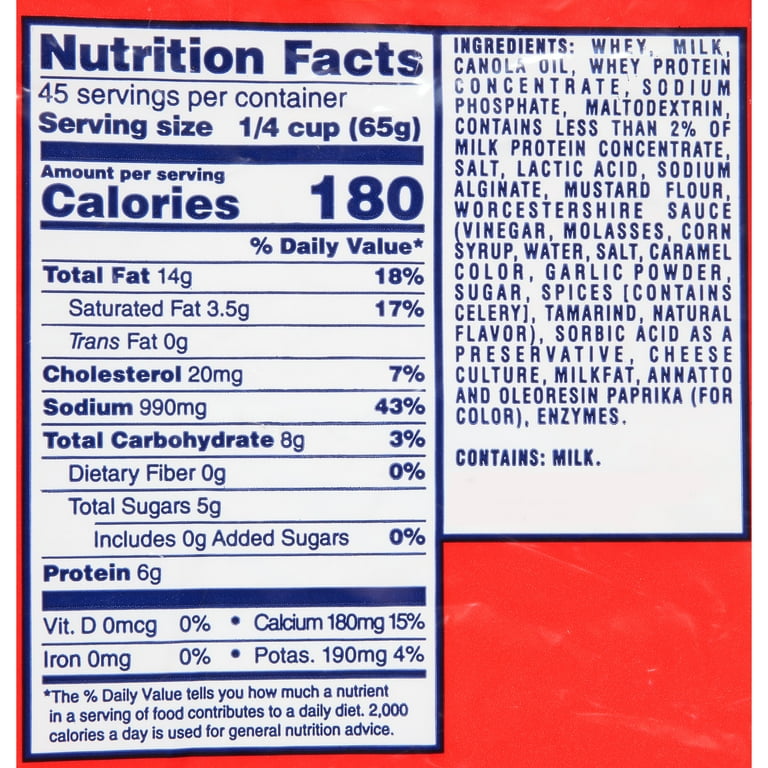
It’s an incredible list of ingredients. You’ve got your whey, canola oil, corn syrup, protein concentrate, mustard flour, garlic powder and sorbic acid. Less than 2% of the product, according to this label, is “cheese culture.” So they add a microscopic element of cheese in the product, and that gives them the go-ahead to claim that their product is “Made with Real Cheese” and “Real Dairy.” But there’s nothing “real” about any of this. It’s all fake.
What you want in actual cheese is a much simpler list of ingredients: Pasteurized Milk, Cheese Cultures, Salt, and some enzymes. And this is one area where federal regulators have actually made authentic products easier to identify.
Watch:
Source: History of Food/YouTube.com
What’s interesting about the video I just played is that it’s probably not real, either. The facts are real — I verified them. But I have no idea if there’s an actual person narrating that footage, or if it’s AI. No narrator ever appears on camera. He maintains the same cadence throughout the entire thing. All of the footage is stock imagery. No one has left a comment. And the script is all based on information from government websites, like the FDA, so for all I know, an AI wrote the script, too.
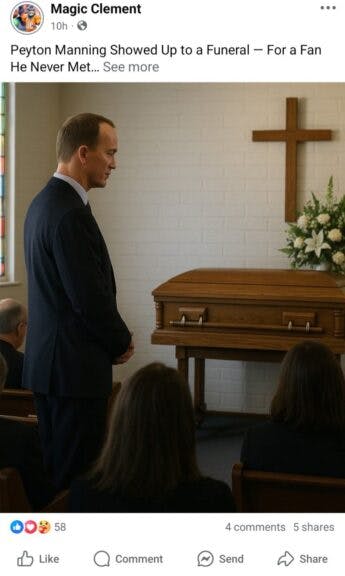
That brings me to yet another area of life that’s becoming almost entirely fake, which is social media. Bots and AI have overrun pretty much every social media platform. Go on Facebook, and you’ll get bombarded with AI videos everywhere you look. Some of the most popular genres involve fake stories about celebrities, complete with sob stories or some other lazy emotional hook.
Here’s Peyton Manning going to a funeral for a fan he’s never met. People loved that one. There’s a whole genre of Peyton Manning AI slop along these lines.
Source: Magic Clement
Then you have videos like this one.
incredible things are happening in the facebook AI slop arena pic.twitter.com/aI5uJt3WSG
— Daniel (@growing_daniel) October 9, 2024
Source: @growing_daniel/X.com
Apparently, an awful lot of people think giraffes are rescued with cranes. There’s something like 23,000 likes on this video. And that sounds pretty bad, but then you realize that those 23,000 likes might not be real, either. A lot of them are probably bots, which drive up engagement for the video. And when engagement goes up, the algorithm is more likely to show the video to more people. And that means more ad revenue for the creator. So social media is full of artificial content generated by bots, and liked by bots, and commented on by bots. It’s bots talking to bots. Layer upon layer of fakeness.
As a result of fraud like this, the truth is, you really can’t tell how many people are actually watching any particular piece of content. It’s also hard to know if you’re debating a real person, when you respond to a comment. And the flip side of this problem is that, very often, legitimate channels (and outlets) will be accused of buying fake engagement, when there’s actually no evidence that they’re doing it. You’ll also see accusations that AI was used to create artwork, just based on a hunch that some people have.
I don’t need to belabor the point. Most people who watch my show are already aware of AI slop. What’s important is recognizing that, as much as we’d like to dismiss AI slop as a unique phenomenon, it’s actually part of a broader trend where reality becomes much harder to discern.
A few weeks ago, we talked about the home buying process, and how many new homes are in very poor condition, even though they were advertised as move-in ready. Many homes also have fake wood and fake wood exteriors now, to the point that it’s hard to buy a home with natural wood. You’re likely to get stuck with “luxury laminate flooring” or vinyl flooring instead. That vinyl flooring is a lot cheaper. It doesn’t scratch easily. It’s waterproof. And it looks like wood, at a distance. The problem is that you’ll almost certainly have to replace it in 20 years, once the top layer is damaged. It starts to fall apart very quickly after that. You can have genuine hardwood floors that last a century, or you can have the imitation that falls apart in a decade.
And increasingly, the fake option is winning out. A decade ago, according to one survey, vinyl flooring accounted for just 6% of all new home flooring. Now it accounts for 30%, making it the second-most popular option (behind carpeting). On the other hand, real hardwood was used in around 37% of new builds back in 2017, but now it’s down to less than 7%. These are estimates, but they give you an idea. People’s homes — the single most important purchase of their lives, the place where they spend the vast majority of their time, the place where they raise their children — are becoming demonstrably more fake, along with everything else.
What do you lose, as a country, when inauthenticity runs that deep? And in the same vein, what happens when fake jobs are created solely for the benefit of women and so-called “people of color”? There’s an awful lot of those fake jobs, as you might have noticed. Around 80% of government employees at the local, state and federal levels are just as incompetent as the DMV or the TSA — and they have the same demographics (which is almost certainly a violation of federal civil rights law). It’s just that you never see these government employees, and they never show up to work. They’re basically in a jobs program.
Not that the private sector is much better, in some cases. 90% of HR Departments serve no purpose. They exist to discriminate against white men and foster a culture of constant paranoia. Meanwhile, Silicon Valley is full of “project managers” who are ripped straight from “Office Space.” They’re supposedly good at “talking to engineers” or whatever, but in reality they spend half their days posting TikToks about all the perks they get at work, like the free lunches and spa days.
Thankfully, ever since Elon Musk fired 90% of Twitter employees, these videos have been harder to find.
But just in case you forgot, here’s one of those videos, from 2022 — just before Elon took over:
@utchattanooga Check out a day in the life of a Twitter employee, and UTC graduate Kaylah Santos! Thank you so much to Brittany, Taylor and Kaylah for participating. We are so proud of your accomplishments 💙💛 #utchattanooga #gomocs #utcnewmocs #utcgrad
It’s a “day in the life” video and she doesn’t say a word about her actual job. She just strikes a bunch of poses, plays with some pillows, gets lunch, shows off the kitchen, and gives clichéd life advice with the maximum possible amount of vocal fry. This is not a job. It is, as it has been described, adult daycare for women.
It’s a phenomenon that you see when interest rates are extremely low, and investors want to maximize their returns — so they send all their money to tech companies, who effectively get billions of dollars in free money.
Now that the economy has changed, and Elon’s philosophy is more common in Silicon Valley, you see less of this. But that just means that the women have stopped bragging on TikTok about their six-figure tech jobs. Based on the employment numbers, many of them are still “working,” somewhere, in some capacity. They’re just wasting some other employer’s time, in some other fake job.
We could go on and on. People adopt fake genders now. They chase fake money and fake art, which is what the NFT craze was all about, and various scam cryptocurrencies are still all about. Fake friends and girlfriends are more common than ever, as well. In fact, one of the most popular scams right now involves getting a text message that appears to be a “wrong number” situation. And then when you respond that the person has a wrong number, they’ll text back, try to get to know you, and then they’ll convince you to log onto their scam crypto website so they can steal your money. One guy in California lost a million dollars in a scam like this. This is a longer video, but we’ll play it because it’s a very common situation.
Watch:
So if you’re following along, his wife dies in December of 2024. And less than a year later, he’s madly in love with a girl he’s never met, who’s much younger than he is. And, at her direction, he’s emptying out his retirement. Now he’s lost a million dollars, and on top of that, he owes $300,000 in taxes for all of those withdrawals, so he might lose his house.
It’s easy to say, well, he’s just an old boomer, he doesn’t understand technology. But the problem here isn’t technology. It’s that he can’t discern reality from fantasy. And that’s a problem that’s only going to get worse, because everyone — from a very young age — is exposed to a wildly distorted perspective on reality. Take music, for example. Autotune used to be a gimmick that one or two performers used, like T-Pain. They even had a T-Pain app on the iPhone, so you could sound like him.
Now all of the performers use it.
Here’s a couple of before-and-afters, to give you an idea:
Source: RoomieOfficial/YouTube.com
In the first case, she clearly has no talent. The autotune is intended to compensate for that. In the second case, later in the video, Ed Sheeran can obviously sing, at least to an acceptable standard. But they autotune him, too. None of it’s real.
And by the way, the musicians don’t even look real anymore, either. Take Sabrina Carpenter and Nicki Minaj for example. After the apparent lip injections, Botox, and hair dye, they’re unrecognizable. No normal human being looks like that. Cosmetic procedures are more popular than they’ve ever been. Even if pop stars are leading the charge when it comes to turning their bodies into a mesh of silicone and plastic, it’s not just rich pop stars. Millions of normal women are doing the same thing. So the epidemic of fakeness extends not just to social media or food or your fake wood floors, but even to the bodies of the people who are interacting with this stuff.
And instead of encouraging people to look the way they naturally look, the most popular influencers are pitching “double jaw surgeries” and “looksmaxing.”
Watch:
Clavicular explains his upcoming $35,000 double jaw surgery that will ascend him 1.5 points…
“They basically make a cut on the lower jaw and move it forward, and apply screws, and the same with the upper jaw” pic.twitter.com/Fi6SK0JCHM
— The Iced Coffee Hour (@TheICHpodcast) March 2, 2026
Source: @TheICHpodcast/X.com
Getting back to my point about bots and fake engagement, there’s another point to be made about this guy, “Clavicular.” To be clear, I’m not accusing him of “buying viewers” or anything like that. But you have to remember how he rose to fame. It happened very suddenly, out of nowhere, in December of last year, when he supposedly ran someone over with his Cybertruck. The story was, the guy was harassing him, got in front of his car, and Clavicular ran him over.
Was that staged? We have no idea. It’s certainly reasonable to ask: Why didn’t the police charge anyone? Why did they immediately determine that “no criminal act” had taken place, and drop it entirely? Why was there no follow-up to that story at all? Whatever the case, he clearly has a very good PR team behind him. They used those viral incidents — real or not — to promote his brand. And now he’s everywhere. In the span of three months, he’s gone from a complete nobody, to the alleged “voice of a generation.” He turned a stunt into total social media domination.
Just a few years ago, that kind of stunt wouldn’t be anywhere near as effective. A lot of podcasters — people like me — got an audience by talking to people, every day, in their cars. I didn’t run someone over with my car, or drop a piano on someone’s head. But that’s now a winning strategy, evidently. Now we have fake influencers giving fake advice about how you can make your body look extremely fake, just like they do.
It’s important to understand that, at some level, people find this to be a very unsettling state of affairs. I’m not convinced that people have any desire to live in a fake world. It’s probably a good sign that Mark Zuckerberg just cancelled his Metaverse after spending $80 billion on it. He also changed the name of his company from Facebook to Meta, on the theory that people were really into fake universes that they could explore in virtual reality. But that didn’t pan out — possibly because, when you spell it out for people, it’s not remotely appealing. There’s something very interesting about that. We are surrounded by fakeness everywhere. And yet when Zuckerberg built a fake world that we could go pretend to live in, and spent $80 billion on it, nobody took him up on the invitation. Is that because deep inside we still yearn for authenticity? Or is it because the real world is already so fake that the metaverse seemed redundant? Or is it a bit of both? I think probably both.
So what is the antidote to fakeness? It’s clear that everything around us is fake. The food is fake, the houses are fake, the music is fake, the movies are fake, social media is fake, the people are fake. What’s the cure? How do we break free from this overwhelming, choking fog of fakeness? Well it isn’t something a government can mandate. It’s not a policy that can be instituted on a mass scale at this point. It has to be done on the individual, personal level. And at the risk of oversimplifying things, the antidote amounts to something of a cliche: “touch grass.” Put the phone down. Immerse yourself in things that are real and immediate. Take on challenges that require you to work with reality rather than construct a fake one. This could be anything. Exercising. Shooting. Hunting. Anything at all. This is one of the reasons I love to fish. It gets me out in nature, in something that is real, doing something real and ancient, in an environment I can’t control, a place that was not constructed by an algorithm specifically to appeal to me. So find your fishing. Find your thing that immerses you in what is real.
Also establish real human connections. This is why you should get married and have children. And focus on the deeper meaning in life. All of this fakery basically carries with it the message that nothing matters, nothing means anything — just make up your own reality and amuse yourself. This is why humans need faith. The only other option, as we’ve discovered, is artificiality and nihilism. Despair. This was basically Kierkegaard’s point, as I understand him (which is only barely, I admit).
And while you’re at it: Read novels. Listen to good music. Watch good films. Even though they’re telling made-up stories in some cases, they’re still speaking to truths about the human condition that can’t be said any other way. This is why I hate AI art so much. It can’t possibly speak authentically about the human experience, which is the whole point of art. These are the things that keep us tethered to reality. Nature. Family. Faith. Art. These are the sources of authenticity. The streams, the tributaries, that fill your life with what is real, what has meaning.
Now imagine the life of a godless, childless liberal who lives in the city and spends their free time ingesting brain rot algorithmic slop. They are living, literally, a life of fakeness. This is the matrix. A life totally devoid of anything real. Nothing tethering them to the deeper realities of existence.
And as depressing as that life is, it’s easy to fall victim to it. That’s especially true for children, who are growing up in a fundamentally different world than any previous generation. We’re talking about a world in which deception is ubiquitous.
The armed robberies are fake.
The social media platforms are fake.
The insurance claims are fake.
The music and the streamers are fake.
The crypto is fake.
The houses are made of fake materials.
The text messages are fake.
The Facebook posts are fake.
The jobs are fake.
The cheese is fake.
Can you control any of that? No, you can’t.
But you do have the power to control whether you become fake as well — whether you become a vessel for all of this deception. And no matter how popular “doomerism” may be, and no matter how intoxicating it may be to say that there’s no way out of this particular doom loop, that’s actually a lot of power.
Every one of us should make the conscious decision, every day, to use it.