On November 2, 1963, South Vietnamese military officers murdered their president of nine years, Ngo Dinh Diem, and took control of the nation’s government. The American hand was invisible at the time, but regime change came to fruition only because of active encouragement by the U.S. ambassador, who believed that a coup would improve South Vietnam’s war effort. In the months that followed, however, South Vietnam experienced a succession of coups and countercoups, whose debilitating effects drew the United States further into the Vietnam war. As the crisis intensified, South Vietnamese and American participants raged against one another about the merits and consequences of deposing Diem. Although most of those individuals are no longer with us, the debate and some of its ardor have survived.
David Halberstam and Neil Sheehan, who were covering South Vietnam for American newspapers in 1963, shaped the first account of the coup. Their version became part of the dominant American narrative of the Vietnam war, known commonly as the orthodox narrative. According to this account, the Diem regime was so weak and unpopular that its demise was inevitable. Considering that Diem’s successors fared so poorly, Diem’s frailty served as proof that the American project of preserving South Vietnam was doomed all along.
Revisionist historians, drawing on the observations of pro-Diem U.S. officials like William Colby and Frederick Nolting, countered that the Diem government fell not because of its own flaws but because of unrealistic American efforts to pressure Diem into rapid political liberalization. They depicted Halberstam, Sheehan, and other American reporters in Saigon as ill-informed neophytes whose follies helped precipitate the coup. In their estimation, South Vietnam could have survived in the absence of the coup, and the war could have ended far differently.
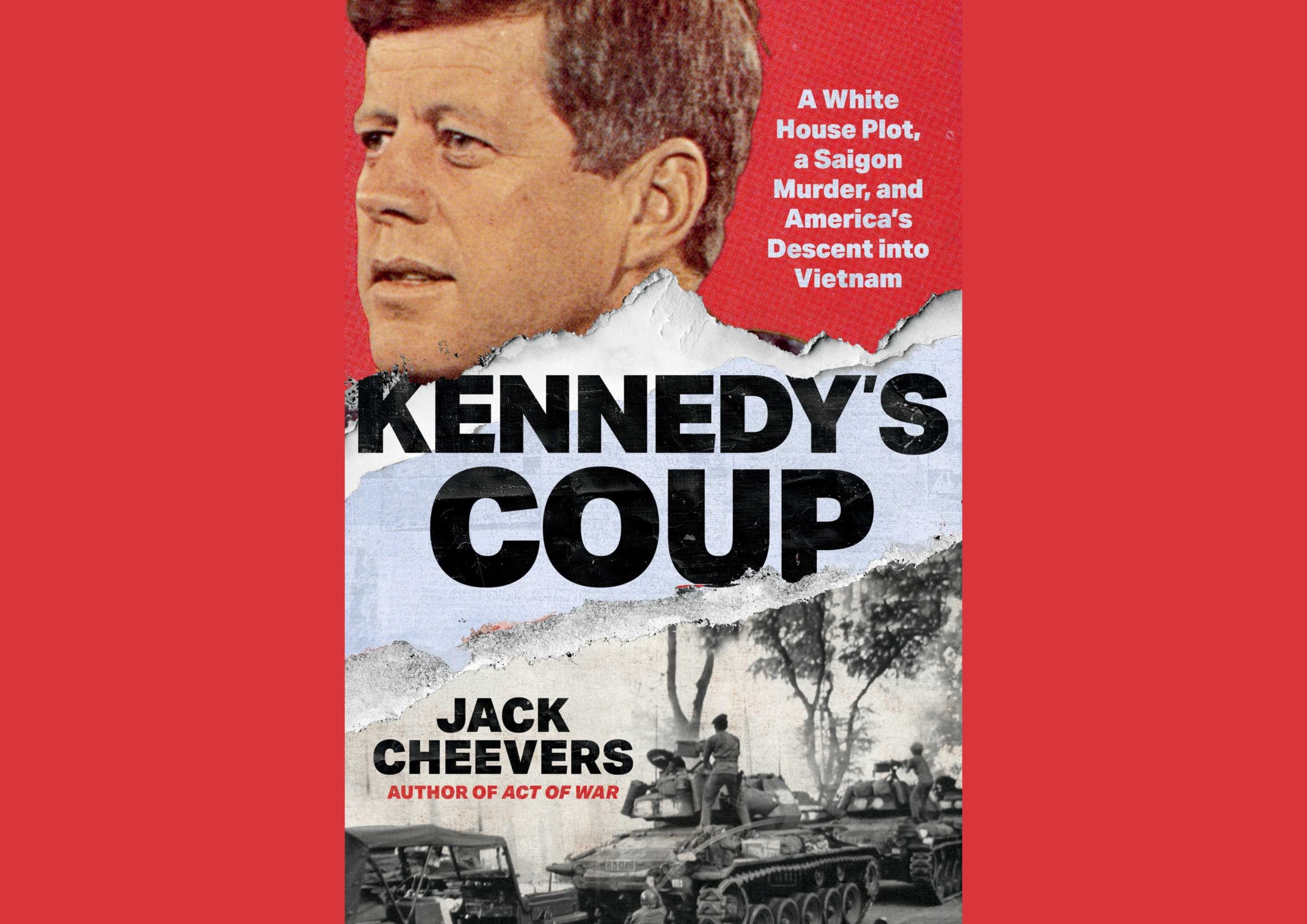
With Kennedy’s Coup, Jack Cheevers purports to change our understanding of the coup, and by extension the war. In the course of very extensive research, Cheevers obtained new materials from archives and the CIA, and interviewed witnesses whose voices have not been heard before. These sources add interesting new details to the story, but they do not shed significant light on the big issues, nor does Cheevers contend that they do. Instead, he seeks to shed new light by reinterpreting the great mass of long-established facts.
Although Cheevers does not adhere uniformly to the orthodox narrative, most of his book resembles it much more closely than its revisionist counterparts. By the spring of 1963, he states, “Diem’s government had hardened into a sclerotic family clique” that “had alienated virtually every segment of South Vietnamese society.” Cheevers lauds the American press corps in Saigon as “a fierce tribe of truth seekers” who skillfully exposed the errors and deceptions of the Diem government.
Continuing in the orthodox vein, Cheevers holds Diem culpable for the government’s mounting conflicts with Buddhist protesters in the spring and summer of 1963. Diem, he contends, could have averted the crisis had he made more concessions to the Buddhists and loosened restrictions on protest activities. Cheevers blames the pivotal pagoda raids of August on Diem’s brother Ngo Dinh Nhu, asserting that Nhu raided the pagodas with his personal troops and used “iron-fist tactics that made even army commanders recoil.” He disregards numerous documents showing that South Vietnamese Army generals not only came up with the idea of raiding the pagodas, but also played leading roles in orchestrating the raids and hailed them afterwards as a great success.
Cheevers also accepts the orthodox view that the Diem government’s severe political deficiencies were matched by egregious military flaws. His cursory treatment of military affairs resembles those of prior orthodox historians, focusing on a small number of South Vietnamese setbacks. He ignores a much larger number of South Vietnamese victories, which revisionists have documented with the assistance of Vietnamese Communist histories that are conspicuously absent from Kennedy’s Coup. To give one of many examples, a March 1965 North Vietnamese assessment concluded that in the period following the overthrow of Diem, “The balance of forces between the South Vietnamese revolution and the enemy has changed very rapidly in our favor. … the bulk of the enemy’s armed forces and paramilitary forces at the village and hamlet level have disintegrated.”
In the sections on September and October 1963, Cheevers begins to diverge from the orthodoxy. Like some revisionists, he emphasizes that White House efforts to coerce Diem into liberalization inadvertently convinced the South Vietnamese generals to turn against Diem. In the meantime, U.S. ambassador Henry Cabot Lodge Jr. had given up on Diem and was trying to unseat the South Vietnamese president behind Kennedy’s back. When Kennedy finally learned of Lodge’s machinations in late October, he tried to rein his emissary in, but he became the victim of his own political skullduggery. A few months earlier, Kennedy had sent Lodge to Vietnam to shift attention and potential blame to a Republican who could challenge Kennedy for the presidency in the 1964 election. Now Kennedy feared he would suffer political blowback if he fired Lodge, and therefore he could not pull the reins tight enough to keep Lodge from setting the coup in motion.
Cheevers describes in some detail how the generals abjectly failed at leading the country after the coup. The ineffectiveness of the initial junta led to a second coup three months later, and others followed in rapid succession, each one further damaging the government. Even coup proponents like Halberstam and Sheehan could not dispute that the generals failed to live up to expectations, which explains why the journalists so vociferously argued afterward that the war had essentially been lost before the coup.
Only in the final chapter does Cheevers make a clear break with the orthodox school. Invoking the pro-Diem officials who inspired the revisionists, he embraces their conclusion that the Diem government fell because of American diplomatic malpractice, rather than Diem’s inherent flaws. Cheevers faults Lodge and other State Department officials for promoting a coup with little comprehension of what would follow, and blasts Kennedy for letting them do so. He also chastises the Kennedy administration for trying to liberalize an authoritarian country in a time of war. “Kennedy would have been well-advised to stop hammering Diem to get rid of Nhu and let the brothers do their best to win the war,” Cheevers writes. “Free and fair elections could never be held, nor strong democratic institutions established, until the Viet Cong were largely cleared out of the country.”
Cheevers acknowledges that Diem’s successors deprived the government of the cohesion that had existed under Diem. On this basis, he concludes that Diem could have kept the government going after 1963, though he differs from revisionists in arguing that Diem would have needed to make substantial reforms to counterinsurgency programs to survive in the long term.
Thus, what is new about Kennedy’s Coup is that it arrives at predominantly revisionist conclusions based on a predominantly orthodox narrative. This novelty may have a certain value. But the conclusions would be more persuasive were they better supported by the narrative.
The book, therefore, would have benefited from greater incorporation of elements of the revisionist narrative. One such element is a deep skepticism of the Buddhist protesters. In revisionist accounts, the Buddhists are more dishonest, more sympathetic to the Communists, and more clearly intent on overthrowing the Diem government than in Kennedy’s Coup, and therefore they show Diem’s actions to be more reasonable, and his political standing to be stronger.
Cheevers would have bolstered his case for the staying capacity of the Diem government had he heeded the revisionist contention that South Vietnam had the upper hand in the war until the coup. He would have strengthened his case for the government’s long-term viability had he covered North Vietnamese deliberations after the coup. In December 1963, the Communist Party’s Central Committee ordered a transition from indecisive guerrilla warfare to decisive conventional warfare, on the premise that South Vietnam’s steep decline after Diem’s demise had made the country ripe for military conquest. That decision gives further reason to believe that if Diem had remained in power, South Vietnam might never have faced a life-threatening offensive, and would have been better prepared to cope with one had it ever come.
South Vietnam might thus have survived and evolved into a vibrant democracy like America’s other Confucian allies in Asia—South Korea, Taiwan, and Japan. The United States could have been spared from hundreds of thousands of casualties, massive financial expenditures, and decades of self-doubt and recrimination.
Kennedy’s Coup: A White House Plot, a Saigon Murder, and America’s Descent into Vietnam
by Jack Cheevers
Simon & Schuster, 688 pp., $35
Mark Moyar holds the William P. Harris Chair of Military History at Hillsdale College and is the author of three books on the Vietnam war.