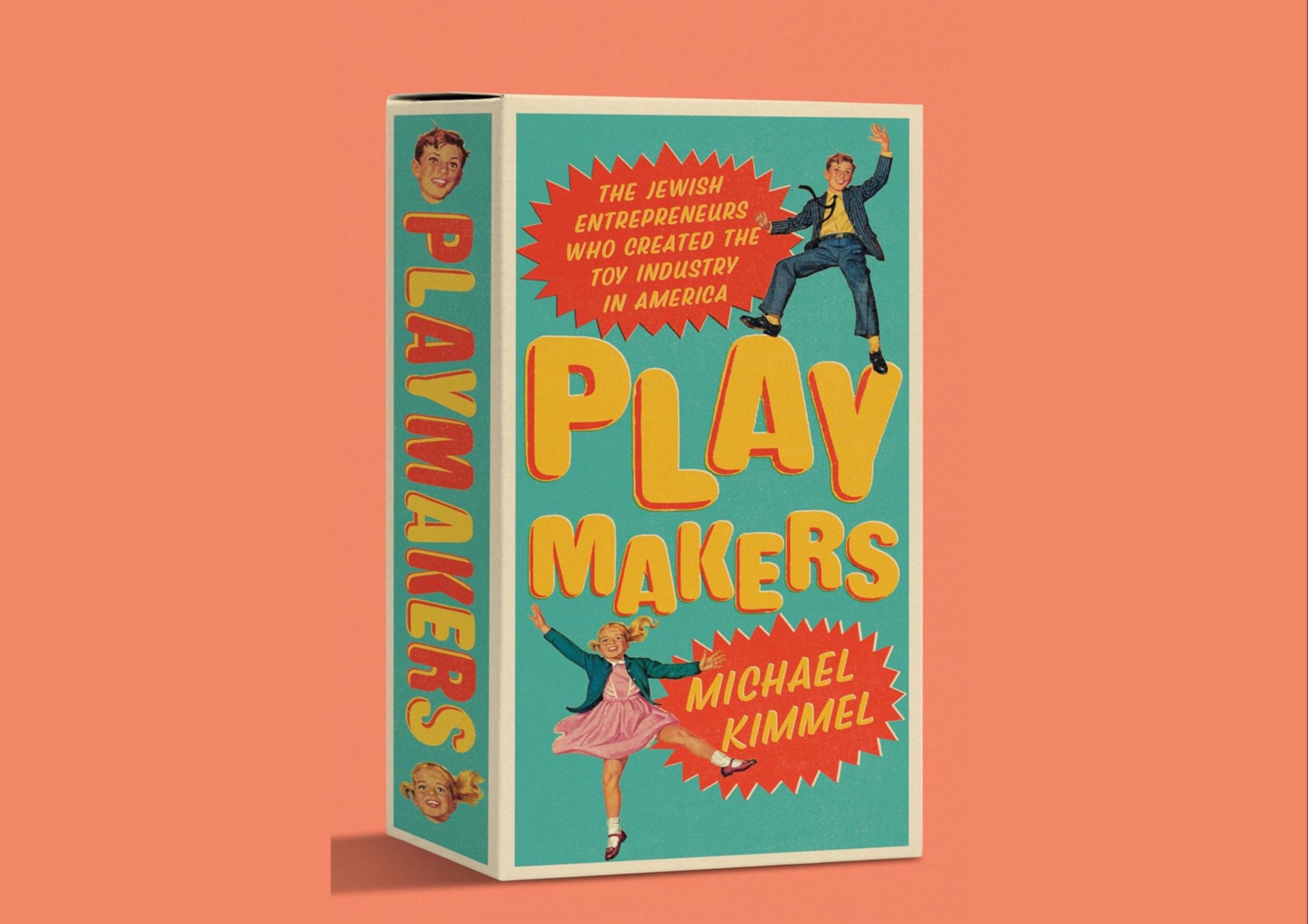
The People of the Book, it turns out, are also the people of the Teddy Bear, Barbie, and Batman.
As Michael Kimmel, SUNY distinguished professor emeritus of sociology, traces in his captivating Playmakers: The Jewish Entrepreneurs Who Created the Toy Industry in America, it all started with a presidential pardon for a bruin. Teddy Roosevelt, on the last day of a hunting trip in 1902 refused to shoot a 235-pound bear that had been tied to a tree by a tracker eager to hand the president a trophy. The merciful moment, immortalized in a Clifford Berryman political cartoon, went viral, even before that was a thing. It inspired Brooklyn candy store owners Rose (née Rachel) and Morris Michtom (né Moshe Michael Charmatz) to craft the first American Teddy Bear in the back of their shop. It would become the country’s most beloved toy ever.
Kimmel (Morris’s great–grandnephew) tells the immigrant tale vividly. Quipping that when he and his relatives introduce themselves, they note their last name “rhymes with victim,” he recounts how Morris and Rose escaped Russian oppression to find safe haven in America, like millions of other Jewish refugees around the turn of the 20th century. When the couple excitedly cranked out those first prototypes, Morris “invited a few local yeshiva boys to help him keep up with demand in the neighborhood. What Jewish boy at the time didn’t know a little tailoring? Jews dominated the garment industry, the schmatta trade, as it was more colloquially known. Slowly, Morris and Rose realized that there would be more profit in selling these little teddy bears than in selling newspapers, even if you carried all the Yiddish ones.”
Legend has it that President Roosevelt himself gave permission for the bear to bear his name, in a note on White House stationery, writing, “I don’t think my name is likely to be worth much in the bear business, but you are welcome to use it.” Only in America.
The candy-shop sewn toy was a turning point in the nature of the concept of youth itself. “It signaled the end of the era of childhood that had prevailed since the nation’s founding,” Kimmel argues, “and it set America on course to enter ‘the century of the child,’ as the social reformer Ellen Key put it in 1900.” What kids wore, what they read, what they played with, what they studied in school, even what they ate, all evolved as the 20th century took shape.
The Jewish entrepreneurs who sparked such transformative changes did so in “a land of both unimaginable riches and entirely familiar bigotries. Yet in spite of—and because of-these struggles, they shared a clear vision for what childhood might look like, a vision borne out in the toys they made, the stores they ran, the comics they drew, and the books they wrote.”
The contributions of the staples of American childhood taken for granted today were overwhelmingly the result of these immigrants’ or their children’s gumption. The list is seemingly never-ending: The Hassenfeld brothers—Henry, Hillel, and Herman—founded Hasbro (as in, “Hassenfeld Brothers”). Don Levine invented G.I. Joe. Ruth Moskowicz and her husband, Elliot Handler, created Mattel. Their children were Barbara and Kenneth, Barbie and Ken. Jack Pressman’s father, Abe, had fled pogroms and settled in Yorkville, on the Upper East Side. Jack founded Pressman Toys, with its immensely popular game of Chinese checkers.
As countless kids imagined the action around their toys, other Jewish creators were providing adventures in page form. Robert Kahn (Bob Kane) invented Batman; Harry Lampert, the Flash; Mortimer Weisinger, Green Arrow and Aquaman; Jacob Kurtzberg (Jack Kirby), Captain America; and Stanley Martin Lieber (Stan Lee), Spider-Man, the Fantastic Four, and countless others. John Goldwater, creator of the quintessentially middle-American character Archie, was born Max Leonard Goldwasser in 1916. Jerry Siegel and Joe Shuster, so the story goes, sketched out the first drawing of Superman on Mama Shuster’s challah board, which she used to prepare traditional bread for the Sabbath. An April 1940 article in the Nazi newspaper Das Schwarze Korps (The Black Corps) criticized Superman’s creator as “an intellectually and physically circumcised chap … the inventor of a colorful figure with an impressive appearance, a powerful body, and a red swim suit.” Margarete Waldstein and her husband, Hans Augusto Reyersbach, escaped Hitler and created Curious George.
Kimmel does acknowledge, of course, that it wasn’t only Jews who crafted American childhood. Benjamin Spock, Walt Disney, Charles Schulz, and Theodor Geisel, he admits, “had as much to do with the creation of American childhood as any other quartet I can think of—and none of them was Jewish.” He does, however, recount that as an undergrad at Dartmouth, Geisel was rejected from pledging by several fraternities because they thought he was Jewish. The children’s literature historian Philip Nel credits this experience as an inspiration for Geisel, under his pen name, Dr. Seuss, to compose the anti-prejudice stories The Sneetches and Horton Hears a Who!
Was there a uniquely Jewish element to all those now-classic contributions? Kimmel suggests there was, albeit subconscious. Judaism for millennia has seen children not as sources of labor but, Kimmel writes, “as pure and wondrous, ‘a garland of roses,’ according to the Talmud. Yiddish Jews believed the ‘child is a blessing to the family,’ just as the people are children to God. According to the historian Jenna Weissman Joselit, they valued children ‘not for their material contributions to the family economy but for the emotional satisfaction—the yidishe nachas—they provided,” as they grew into their own (hopefully) confident and wise selves. Kimmel cites another historian who suggested that “Hillel,” the ancient Jewish sages, “was the forerunner of Montessori.”
In considering his long-lost relatives’ motivations in molding that first Teddy Bear, Kimmel notes that “bears are very prominent in the mental landscape of the Russian countryside. They figure prominently in Russian children’s literature. … Perhaps the soft cuddly ursiform creature was a way to tame the wild but still keep it familiar, to render it harmonious with the increasingly urban landscape. The most frightening icon of wildness was transformed into a cute and cuddly toy for children. Tethering him somehow made the world symbolically safer.” Jewish immigrants, in other words, sparked the societal transformation that would enable a century and counting of children to sleep safer at night, bear cuddled in arms, as they drifted off into the American Dream now available to all.
Playmakers: The Jewish Entrepreneurs Who Created the Toy Industry in America
by Michael Kimmel
W.W. Norton & Company, 432 pp., $32.99
Stuart Halpern, senior adviser to the provost and deputy director of the Straus Center for Torah and Western Thought at Yeshiva University, is the author, with Wilfred M. McClay, of Jewish Roots of American Liberty: The Impact of Hebraic Ideas on the American Story (Encounter).