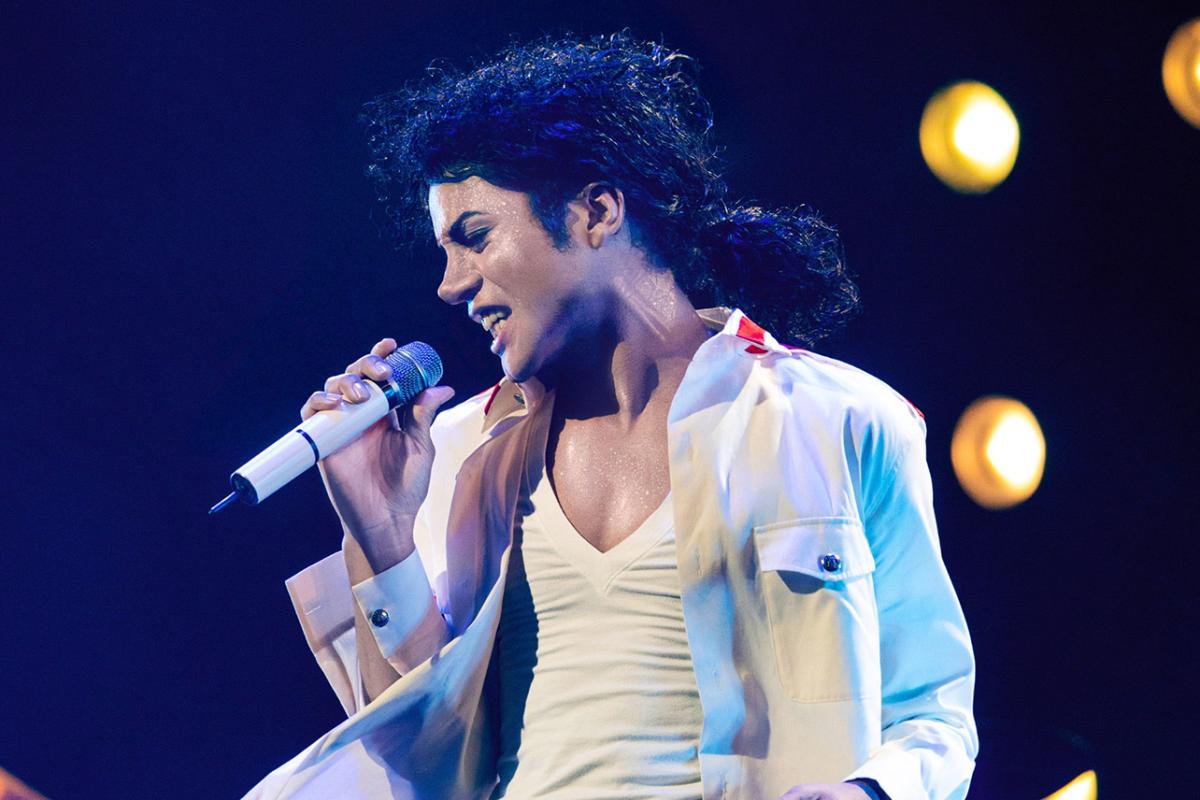
In addition to the well-documented box office success of many pop-musician biopics – not surefire moneymakers, but pretty consistent ones for over 20 years now – there’s another track record that likely keeps actors signing on: the Academy Awards. Jamie Foxx won a Best Actor Oscar for playing Ray Charles in the 2004 hit Ray; a year later, Reese Witherspoon won Best Actress for playing June Carter Cash in Walk the Line, opposite a nominated Joaquin Phoenix as Johnny. The dude from Mr. Robot will forever be Academy Award Winner Rami Malek thanks to Bohemian Rhapsody. And though they didn’t win, Austin Butler and Timothée Chalamet cemented their next-big-thing reps when they received Oscar nominations for Elvis and A Complete Unknown, respectively.
All of this points to some possible Oscar heat for Jaafar Jackson, nephew of the late Michael Jackson, who plays his uncle in the new biopic Michael. Jackson is a newcomer to film; his spare CV prior to this role consists primarily of messing about on the edge of his family’s brand name. He was on the reality show Living with the Jacksons. He was in a Tito Jackson music video. He released a couple of singles; no album. And now he gets to pretend to be Michael.
Given the Academy’s long-standing bias against male ingenues, it would be remarkable for the 30-year-old Jackson to get a nomination on his first movie. There’s a small but notable number of performers who have scored supporting nominations for their first-ever roles; far fewer have done so in the leaning category, and even fewer than that in the Best Actor category. Among the rarified few: Orson Welles (who was also writing, directing, and producing Citizen Kane) and James Dean (who was dead by the time he was nominated for his film debut in East of Eden). It should not shock anyone that the guy hired primarily for his family resemblance to a singer is not quite in that league.
At the same time: Of the ten biggest-grossing musician biopics from this century, six received acting Oscar nominations. Unless Michael turns out to be a surprise bomb, it will likely hit at least number three on that chart. (There’s a very good chance it could end its run at #1; the #2 spot is all but assured.) If it does that and fails to score a nomination for Jackson, it would be the highest-grossing such movie without a Best Actor nod.
Records are made to be broken and statistics are made to be defied; Michael Jackson himself had the most Top 10 singles from one album, until he didn’t. Moreover, Jaafar Jackson’s work in Michael doesn’t really have the chance to ascend to the heights of his predecessors. Even taking into account that some of those performances are showy impressions more than full-bodied characters, Jackson is doing something more cautious and focus-grouped in this Antoine Fuqua-directed, estate-approved, poster-thin movie.
The idea behind the film’s characterization of Jackson seems to be that he was a pure soul, forever searching for the childhood he experienced only in bits and pieces thanks to the domineering hand of his abusive father Joe (Colman Domingo), who he finally escaped by gathering the strength to go permanently solo. Jackson plays MJ as a sweet, soft-spoken guy who can unleash astonishing physicality on stage, to the point where he can barely keep still when singing through recording sessions.
The movie’s singing, of course, is the real Jackson, expertly remastered and dubbed to the actor’s performance; the movie seems freaked out about what the audience might do if it were forced to contend with a full imitation, which leaves the performance feel more like a simulation. It’s a Michael Jackson party trick, and the dramatic scenes follow suit. Setting aside what the movie ignores about the major accusations leveled at Jackson later in his career – and that is a heavy, heavy lift, to be clear, made heavier by the film’s insistence on portraying Jackson as a slightly eccentric but entirely understandable innocent – even in the realm of the cornball biopic, there’s not much for the actors to do here. As Jackson passively moves through his beyond-perfunctory dialogue scenes, you can see almost the entire cast shrink and wilt to that do-less level (save perhaps Domingo, who is hard to muffle). It’s not inspired minimalism; it’s just a whole cast treading very lightly.
As a result, Michael feels flimsy and shallow, even for its genre. No one in it gets to act like a real person, almost as if some messiness would only make the film’s anodyne portrait of its star look as weird as the guy genuinely was. (Again, even if you can set aside the child abuse allegations, even looking at his life before the abuse allegedly took place: He was a weird dude.) Most of the acting takes a backseat to the undeniable power of Jackson’s greatest hits, and that’s what a lot of the audience will pay to see: A Michael Jackson Experience. Though Jackson’s estate would doubtless be pleased by awards attention, and the hardcore Jackson stans who mobilize online will surely be outraged when it doesn’t get any, deep down this movie isn’t concerned with being the kind of movie that wins Oscars. To do that would require more than the filmmakers are willing to give. They would have to commit themselves, however carefully, to something more complicated than recreating awe.
Jesse Hassenger (@rockmarooned) is a writer living in Brooklyn. He’s a regular contributor to The A.V. Club, Polygon, and The Week, among others. He podcasts at www.sportsalcohol.com, too.