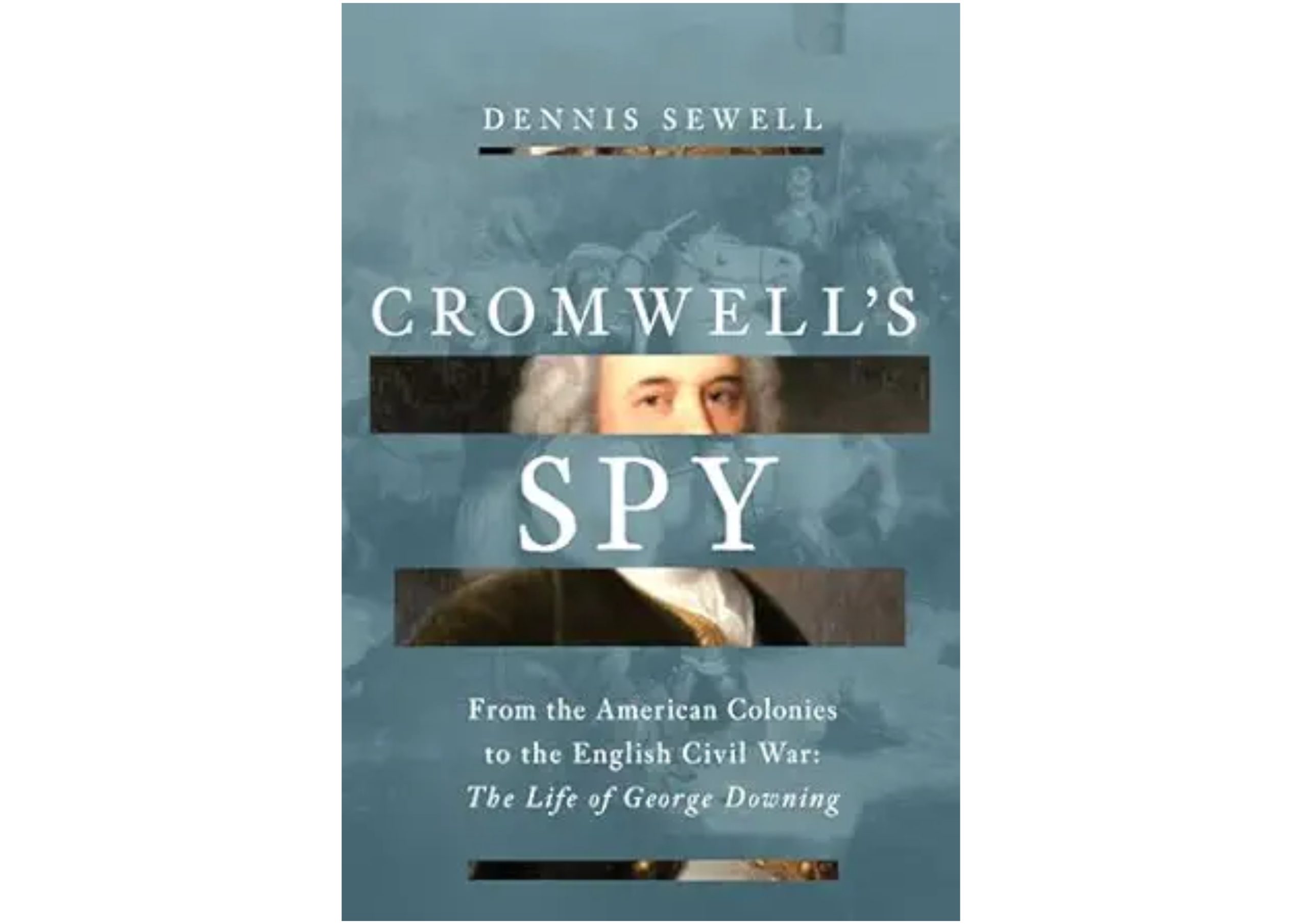
REVIEW: ‘Cromwell’s Spy: From the American Colonies to the English Civil War: The Life of George Downing’ by Dennis Sewell
Today, Sir George Downing is remembered, if at all, for the street and row of brick houses in London that bear his name. This happens to be the address of Britain’s prime ministers, the place where the cabinet meets and where the organs of the British state are meant to be held accountable to the will of the people. It is a great irony then, and perhaps mildly appropriate, that Downing the man was as cynical and traitorous a figure as the 17th century ever produced. Winston Churchill, while residing in his edificial legacy nearly three centuries later, would remember him unflatteringly as “a profiteering contractor.” All but forgotten however are the elaborate contours of Downing’s career: spy, diplomat, financier, parliamentarian, early New Englander, and member of Harvard’s first graduating class.
Dennis Sewell’s biography of the Restoration Era Machiavel is one that accomplishes the rare feat of summoning a figure both forgotten and decidedly relevant. Downing’s life is the story of modern Britain’s painful birth, of a damp North Atlantic island sorting its own domestic affairs, consolidating its global influence, and teetering precariously on the cusp of empire.
George Downing was born in Dublin in 1623 but was fated to become a New Englander. In the late 1630s, the family was among the 20,000 Puritans who sailed for the Massachusetts Bay Colony, a less deadly enterprise than that of the first pilgrims who’d founded Plymouth during the beginning of the last decade and had succumbed in large numbers. Downing’s maternal uncle was John Winthrop, the governor of Massachusetts Bay, and his father, Emmanuel Downing, was a notable barrister. He was sent off to Harvard in 1638, not long after it was first established by flotsam from the University of Cambridge and a sizable bequest from the eponymous John Harvard.
“Harvard was founded by Puritans in the pious hope that it would turn out saints, but in George Downing it apparently summoned a demon,” Sewell writes. It was also a pretty odd place back in the day. During Downing’s first year as a student, a scandal erupted when Nathaniel Eaton, master of the college and “brutal sadist” took to beating his pupils well beyond what seemed reasonable. His wife, meanwhile, had a weird habit of “thickening the hasty pudding” with goat’s dung. Undergraduates took their first lectures at 7 a.m. and were required to converse at all times in Latin.
When these seven battle-hardened polyglots (Greek, Latin, Hebrew, Chaldean, and Syriac were required coursework) received their Harvard degrees in 1642, George Downing was second in line. The order of precedence was likely determined by the faculty’s estimate of “to what degree each would shine in their future careers.” After a stint as Harvard’s first tutor, Downing took to the Caribbean where he preached for a time, before setting sail for England as it lurched through revolution and civil war.
Sewell struggles to deliver on one of his core assumptions, namely that Downing was a man of singular treachery, so notable as to endure in its infamy centuries after his death. He does seem to be particularly well suited to his violent and dangerous times, however. There are so many turncoats and traitors in these pages that keeping track of them all proves a meaningful challenge. Downing may have outdone them in his cleverness, but perhaps not in his wickedness.
In England, Downing so impressed Oliver Cromwell that he appointed him head of military intelligence. On undercover missions in Scotland, he proved particularly good at this work. When the New Model Army marched into Edinburgh, Downing’s agents were already holed up in the castle with the last defenders, a prime position from which they facilitated the handover of the city. He was later trusted enough to be sent abroad, meeting with Europe’s leading statesmen, negotiating backroom deals, and, as always, gathering intelligence.
In 1660, with the Restoration of Charles II, Downing managed to not only keep his head while dozens of republicans and conspirators in the regicide of Charles I—his former friends and allies—were hunted down and brutally executed. He kept his prominent roles as envoy to The Hague and as Teller of the Exchequer. In some instances, it was Downing himself who did the hunting, exposing one nest of former allies and securing their rendition from Holland. He later managed to help secure New Amsterdam from the Dutch (a second Downing Street runs through New York’s Greenwich Village).
Downing emerges as a man riven with contradictions. He was at once a Puritan and deeply amoral. Fantastically wealthy, he was also incredibly tight fisted. In his old New England stomping grounds, “doing a George Downing” became known for acts of particular treachery. Writing the better part of two centuries after his death, President John Adams would recall Downing as both a “dog” and a “scoundrel.” But the man adopted a pragmatism that solved many complicated problems to his country’s benefit. While not quite a full biography of the man, Sewell has made a gripping, impeccably literate study of one of England’s (and New England’s) forgotten sons. One might best judge Downing in remembering, “The civil war had a way of making double dealers out of even the most honest men and women.”
Cromwell’s Spy: From the American Colonies to the English Civil War: The Life of George Downing
by Dennis Sewell
Pegasus Books, 384 pp., $32
Carson Becker is an American writer whose work has appeared in the Washington Examiner and other outlets.